
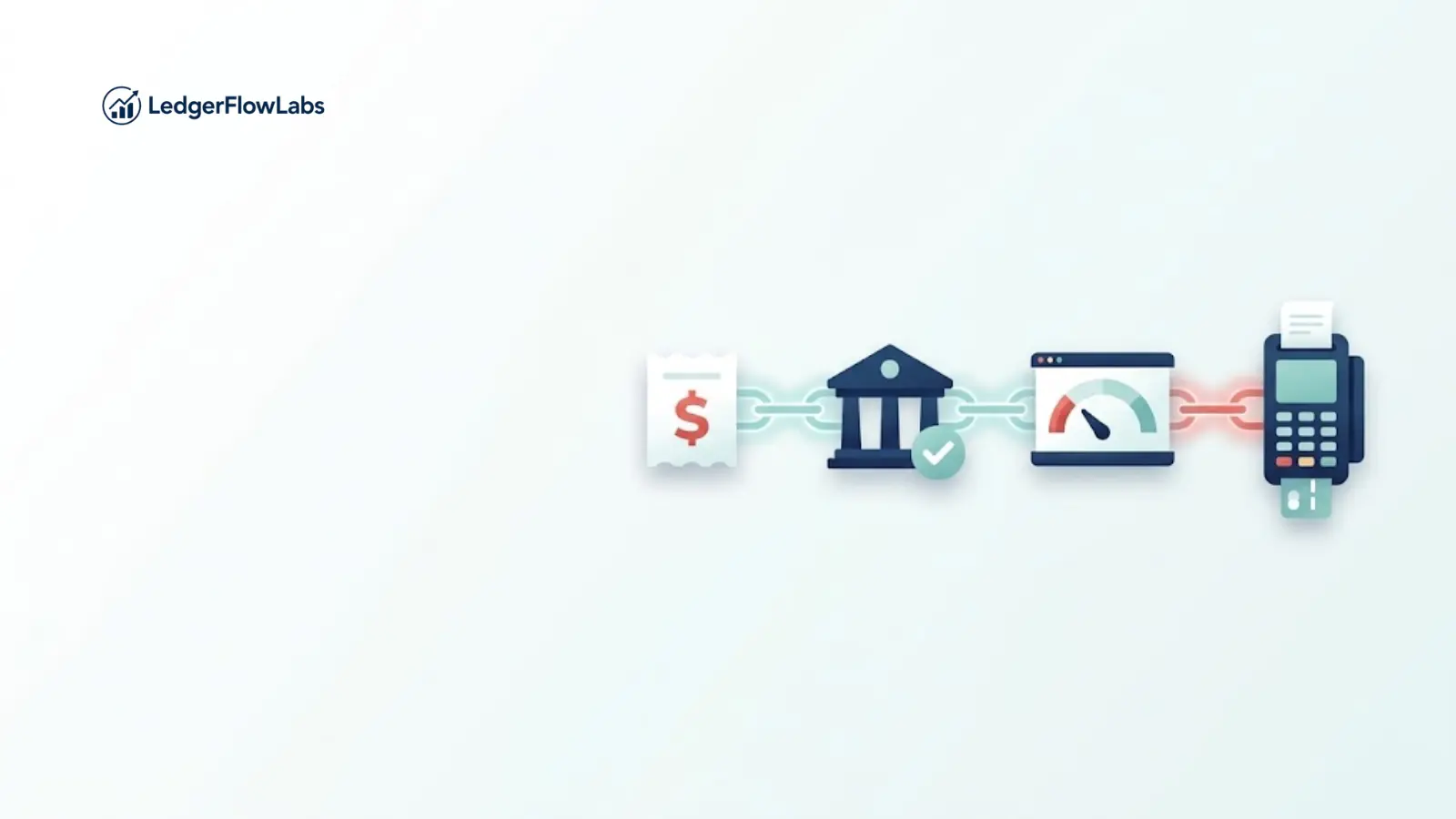
How does an overdraft fee happen? An overdraft fee is charged at a specific moment: when a transaction is presented to the bank for final payment and the balance the bank measures is too low to cover it. At that point the bank decides whether to pay the transaction anyway or return it. If it pays, and the account's settings allow a fee for that type of transaction, the fee is added. Four things have to line up: a transaction posts, the measured balance is short, the bank pays it, and the fee rule applies.
Most people only see the result, a fee line on a statement. This guide slows the process down so each step is visible, which makes it much easier to trace where a particular fee came from.
The four conditions that all have to be true
An overdraft fee is not a single event. It is the end of a chain, and every link has to be present.
- A transaction is presented for payment. A card purchase settles, a check is cashed, or an automatic payment arrives.
- The balance the bank measures is short. Not the balance you last looked at, but the one the bank's system checks at that moment.
- The bank chooses to pay rather than return. Banks can decline or return some transactions instead of covering them.
- A fee rule applies to that transaction type. Federal rules treat debit card and ATM transactions differently from checks and automatic payments.
If any one link is missing, there is no overdraft fee. There may be a declined card, or a returned payment with a different fee, but not an overdraft fee. The sections below take each link in turn.
Link 1: when a transaction actually hits the account
A purchase does not land on the account at the moment you pay. It lands when the merchant settles it, which can be hours or days later.
For a debit card, there are two moments:
- Authorization, when the bank approves the purchase and sets the amount aside.
- Posting, when the merchant sends the final charge and the bank records it.
Checks and automatic bill payments skip the first moment. They simply arrive and post, often without warning in the banking app until they appear. The guide to pending vs posted transactions shows why the gap between these two moments exists and how long it tends to last.
This gap is the root of many surprising fees. A purchase can be approved when the account has plenty of money and then post on a day when it does not.
Link 2: which balance the bank checks
Accounts carry two balances, and the bank's own terms decide which one is used to test for an overdraft.
- The ledger or current balance counts only transactions that have fully posted.
- The available balance starts from the ledger balance, subtracts pending charges and holds, and adds deposits that have been released.
The Consumer Financial Protection Bureau described the available balance this way in its Circular 2022-06 on overdraft fee assessment practices (read September 27, 2026): it is "generally the ledger balance plus any deposits that have not yet cleared but are made available, less any pending (i.e., authorized but not yet settled) debits."
The same circular, dated October 26, 2022, describes the sequence that surprises people most. A debit card purchase is approved while the account has "sufficient available balance," but "due to intervening authorizations, settlement of other transactions (including the ordering in which transactions are settled), or other complex processes," the bank finds the balance insufficient when the purchase settles, and a fee is assessed. The industry shorthand for this is "authorize positive, settle negative."
The article on available balance vs actual balance has worked examples of how far apart the two numbers can drift in an ordinary week.
Link 3: pay it, or send it back
When a transaction arrives and the measured balance is short, the bank has two broad options.
Pay it. The bank covers the shortfall, the account goes below zero, and an overdraft fee may be added. The account holder then owes the negative balance plus the fee.
Return or decline it. For a card purchase at the register, this usually means the card is declined. For a check or automatic payment, the item is returned unpaid. According to the CFPB's answer on what to do if a bank charged a fee for overdrawing an account (read September 27, 2026), a returned item may bring "a non-sufficient funds (NSF) fee from the bank or credit union, which is often the same amount as an overdraft fee." The company that was expecting the payment may charge its own returned payment fee as well.
Which option the bank takes, and on which transactions, is spelled out in its account agreement and overdraft disclosure.
Link 4: the transaction type decides whether a fee is allowed
This is the link most people have never been told about. Under federal Regulation E, one-time debit card purchases and ATM withdrawals are treated separately from everything else.
The rule, at 12 CFR 1005.17(b)(1), says a bank may not charge a fee for paying an ATM or one-time debit card transaction through its overdraft service unless it has given the account holder a written notice about the service, a reasonable chance to agree, obtained that agreement, and confirmed it in writing. This is the "opt-in."
The CFPB's answer page draws the line plainly: "Banks are allowed to charge overdraft fees for checks and recurring electronic payments, even if you did not opt in."
So the same shortfall can play out differently depending on what caused it:
| Transaction type | Not opted in | Opted in |
|---|---|---|
| One-time debit card purchase | Usually declined, no overdraft fee | May be paid with an overdraft fee |
| ATM withdrawal | Usually declined, no overdraft fee | May be paid with an overdraft fee |
| Check | May be paid with an overdraft fee or returned with an NSF fee | Same |
| Automatic bill payment (ACH) | May be paid with an overdraft fee or returned with an NSF fee | Same |
| Recurring debit card payment | May be paid with an overdraft fee or returned with an NSF fee | Same |
Whether an account is opted in is recorded by the bank, and the bank can confirm the current setting.
How does an overdraft fee happen in a real week?
Here is a sequence with made-up figures, used only to show the order of events. No fee amount is included, because fees are set by each bank and differ widely.
| Day | Event | Available balance | Ledger balance |
|---|---|---|---|
| Monday morning | Starting point | $120 | $120 |
| Monday noon | $45 debit card purchase approved, pending | $75 | $120 |
| Monday night | $90 automatic utility payment arrives and posts | Negative $15 | $30 |
| Tuesday | The $45 purchase settles | Negative $15 | Negative $15 |
| Wednesday | Paycheck arrives by direct deposit | Positive again | Positive again |
Look at Monday night. The utility payment is an automatic payment, so no opt-in is needed for a fee. The available balance is already short because of the pending card purchase, even though the ledger still shows $30. If this bank measures available balance and chooses to pay, the utility payment is where the fee appears.
Now look at Tuesday. The card purchase was approved when there was room. It settles into an account that is already negative. Whether a second fee follows depends on the opt-in setting and the bank's own policy on fees for transactions approved with a positive balance.
The piece on autopay overdraft risk covers why scheduled payments are so often the transaction that tips a balance over.
The deposit that arrived one day too late
In the example, the paycheck landed Wednesday. Had it arrived Monday, nothing would have gone wrong.
Timing of incoming money matters as much as outgoing. Banks have processing cut-off times, and a deposit that arrives after the cut-off may be treated as the next business day. The article on how long a direct deposit takes to clear explains why the same paycheck can land on different days.
Order matters too. When several transactions post on the same day, the order in which the bank processes them can change how many of them find the account short. The circular quoted above lists "the ordering in which transactions are settled" as one of the causes, and the bank's account agreement describes the order it uses.
Where the rules come from, and what varies by state
The opt-in rule described above is federal and applies across the US. Beyond that floor, much of what happens is set by each bank's own terms: which balance it measures, whether it pays or returns, how many fees it charges in a day, and whether it offers a small-shortfall cushion.
State-chartered banks and credit unions answer to their state regulator as well as federal ones, and state consumer rules can differ. Rules for a specific account depend on the bank, its charter and the state, so the account agreement and the state banking regulator are the sources for what applies in a given case.
Tracing a fee on your own statement
When an overdraft fee appears, the statement usually holds enough information to rebuild the chain:
- The fee line and its date.
- The transaction posted just before it. That is usually the one that triggered it.
- That transaction's type. Debit card, ATM, check, or automatic payment.
- The pending history in the app for the days before, which shows what holds were in place.
- The account agreement, which states which balance the bank uses and its fee policy.
If the chain does not add up, the bank's customer service can explain how the fee was assessed. If a dispute cannot be resolved with the bank, the CFPB accepts complaints about bank accounts.
Frequently asked questions
How does an overdraft fee happen if my balance was positive when I paid?
The fee is decided when a transaction posts, not when it is approved. Between approval and posting, other charges, holds or automatic payments can lower the balance the bank measures. The CFPB described this "authorize positive, settle negative" sequence in its October 2022 Circular 2022-06.
Can I get an overdraft fee on a debit card purchase without opting in?
Under federal Regulation E, a bank may not charge an overdraft fee for paying a one-time debit card purchase or ATM withdrawal unless the account holder has opted in. Without opt-in, those transactions are usually declined instead. Checks and recurring payments are not covered by that rule.
What is the difference between an overdraft fee and an NSF fee?
An overdraft fee is charged when the bank pays a transaction the account could not cover. An NSF fee is charged when the bank returns the transaction unpaid. The CFPB notes an NSF fee is often the same amount as an overdraft fee.
Does the bank use my available balance or my ledger balance?
It depends on the bank. Some measure the available balance, which subtracts pending charges and holds, and some use the ledger balance. The account agreement or overdraft disclosure states which one applies.
Are overdraft rules the same in every state?
The debit card and ATM opt-in rule is federal. Many other details are set by each bank, and state-chartered institutions also answer to a state regulator. The account agreement and the state banking regulator are where the rules for a specific account are found.