
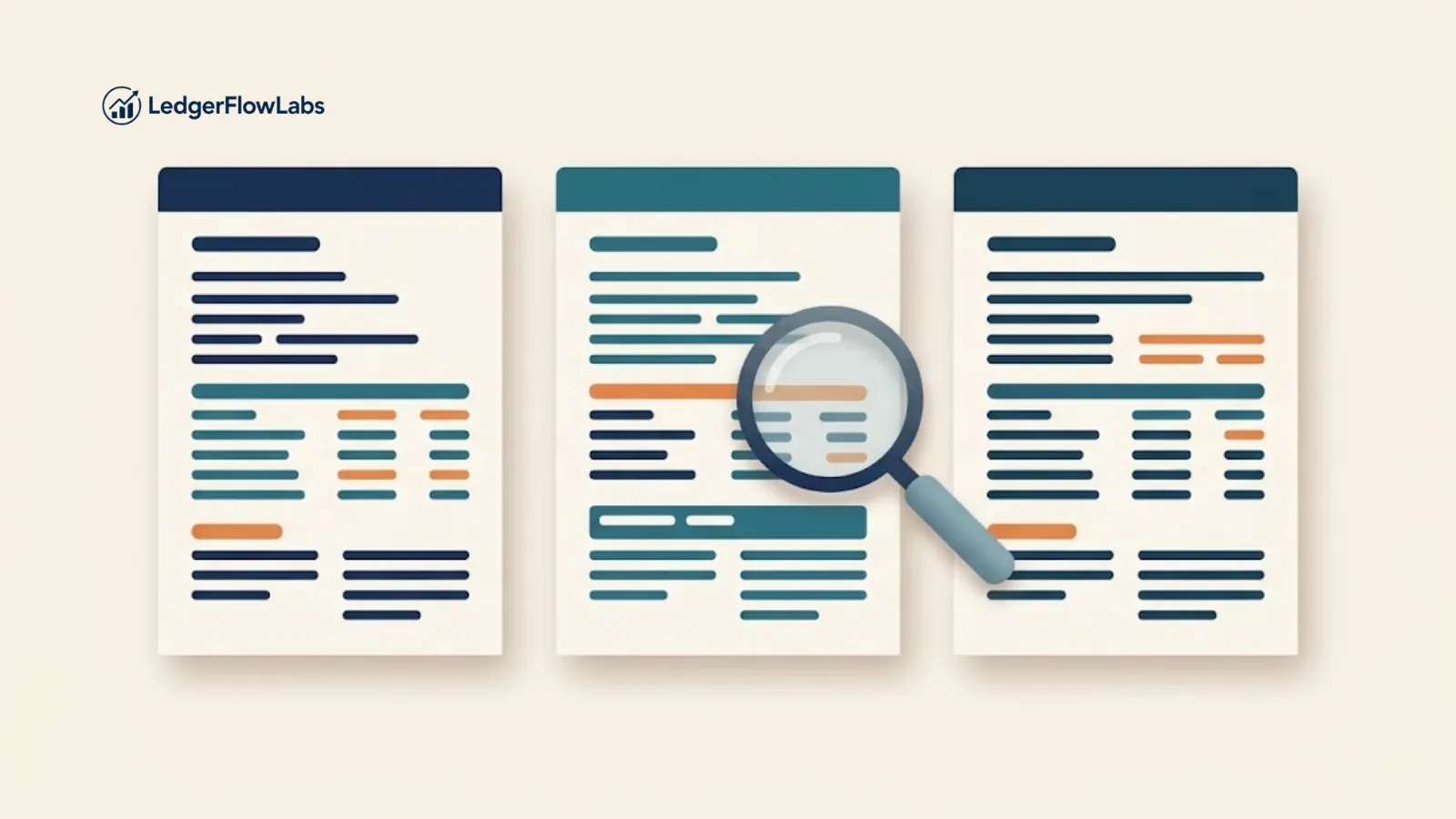
Your credit reports are different because Equifax, Experian and TransUnion each build a separate file from whatever creditors choose to send them, and creditors are not required to report to every credit reporting company. Add in different update timing, different retention of older entries and small differences in how each bureau matches incoming data to your identity, and three files that do not match is the normal result rather than a sign of an error.
Where this applies: the United States, under the Fair Credit Reporting Act. Every source below was read on October 3, 2026. This explains why three documents disagree and is not advice about any account on them.
Three companies, three separate files
There is no single national credit file that the three bureaus share. They are competing private companies, and each assembles its own report.
The CFPB describes credit reporting companies, also known as credit bureaus or consumer reporting agencies, as companies that compile and sell credit reports. The word that does the work there is "compile." Nothing arrives at a bureau automatically. A lender decides to send data, decides which bureaus to send it to, and decides how often.
The CFPB's page on what a credit report is, last reviewed January 29, 2024, states it directly: creditors are not required to report to every credit reporting company. That single sentence explains most of the gaps people find when they lay three reports side by side.
The law reflects the same structure. Under 15 U.S.C. 1681g(a), each consumer reporting agency must disclose to you all information in its file on you. Its file, not the file.
Why are my credit reports different: five causes, in order of how often they explain it
| Cause | What it looks like on the page | Normal or worth checking |
|---|---|---|
| A creditor reports to some bureaus and not others | An account present on one report, absent from another | Normal |
| Update timing | The same account with three different balances | Normal |
| Different retention of older entries | A closed account still on one report, gone from another | Normal |
| Identity matching differences | Different name spellings, old addresses, a former employer on one file only | Usually normal, sometimes a sign of a mixed file |
| An error or fraud that reached one bureau only | An account, inquiry or address you do not recognize | Worth checking |
The first three account for the great majority of differences, and none of them is a defect in any of the three documents.
Reporting coverage. Some creditors report to all three bureaus, some to one or two, some to none. Smaller lenders, credit unions and certain installment products are the usual absentees.
Timing. A balance on a credit card report is a snapshot, not a live figure. Issuers generally send the balance from the close of a billing period, which is why your card can read as paid in full in the app and still show a balance on a report, a mismatch explained in the difference between a statement cycle and a calendar month. Three bureaus receiving that snapshot on three different days will show three different numbers, and the same mechanism, a figure that only looks wrong because of when it was captured, is behind the gap between your available balance and your actual balance.
Retention. Adverse items age off on the schedule in 15 U.S.C. 1681c, which excludes most adverse items older than seven years and bankruptcies more than ten years old from the report. Non-adverse closed accounts have no statutory end date, so how long each bureau keeps them is its own policy, and they do not all drop the same entry in the same month.
Identity matching. Each bureau matches incoming data to an existing file using name, address and identification details. A maiden name, a middle initial, a misspelled street or a recent move can route one creditor's data to a slightly different version of you at one bureau.
A field-by-field way to compare three reports
Reading three reports end to end invites the eye to skip. Comparing one field across all three at a time does not. This is the part of the job almost no page lays out, and it turns a vague sense that something is off into a specific list.
| Field to compare across all three | What a legitimate difference looks like | What is worth a closer look |
|---|---|---|
| Name, former names, date of birth | A maiden name or middle initial on one file | A name that has never been yours |
| Current and former addresses | An old address missing from one file | An address you have never lived at |
| Account inventory | An account absent from one bureau | An account you never opened |
| Open and closed status | A closure reflected on one report first | An open account you closed years ago |
| Credit limit and high balance | A limit increase not yet everywhere | A limit far from the one on your agreement |
| Balance and the date it was reported | Three balances with three different as-of dates | A balance on a loan you paid off |
| Payment history grid | A recent month missing on one file | A late mark you can disprove with records |
| Inquiries | Different lists, since each bureau logs only its own | A hard inquiry for an application you never made |
| Public records | Present on one file only | A record belonging to someone else |
Two habits make that comparison honest. Pull all three reports close together in time, because comparing a report from January with one from June manufactures differences that were never there. And read the as-of date beside every balance before concluding the balance is wrong, for the same reason a transaction can be real and still invisible for a few days, which is the subject of pending versus posted transactions.
The differences that are worth disputing
The test is not whether the three files disagree. It is whether any single entry is inaccurate or incomplete on the file it sits on.
Worth a dispute:
- An account, inquiry or public record that is not yours.
- A payment marked late that your records show arrived on time. Whether a payment counted as late at all depends on the creditor's reporting threshold rather than the due date, as set out in when a payment is actually late.
- A balance, limit, status or date that contradicts your own statements.
- Personal details that belong to another person, which can indicate a mixed file.
Not a dispute, because nothing is wrong:
- An account missing from one bureau. Creditors are not required to report to every company.
- Three balances with three as-of dates.
- An older closed account on one report and not another.
Disputes go to each bureau whose report shows the error and to the company that supplied the information. Both must correct inaccurate or incomplete information and both must do it free of charge. Free reports from all three nationwide bureaus are available at AnnualCreditReport.com, and a complaint can be submitted to the CFPB.
Reports and scores are two different things
A question about three different scores is a different question from three different reports, and they are often merged.
Reports are the underlying records. Scores are calculated from a report by a scoring model, and there is more than one model and more than one version of each model in use. That means two scores can differ because the underlying files differ, or because the models differ, or both at once. A difference in scores does not by itself tell you that a report contains an error, and the only way to find out is to read the reports.
Frequently asked questions
Is it normal for all three credit reports to be different?
Yes. Each bureau compiles its own file, and the CFPB says creditors are not required to report to every credit reporting company. Different coverage, different update timing and different retention of older entries all produce legitimate differences.
Which of the three credit reports is the correct one?
None of them is the master copy. Each is correct about the data that bureau received. Under 15 U.S.C. 1681g(a), each agency must disclose the information in its own file, and a lender sees whichever report it pulls.
Why does one bureau still show an account the others dropped?
Adverse items are time limited by 15 U.S.C. 1681c, but closed accounts with no adverse history have no statutory end date, so how long each bureau keeps them is its own policy.
Should I dispute with all three bureaus?
Disputes go to each bureau whose report actually shows the error, and to the company that reported the information. An account that is simply absent from one bureau is not an error to dispute.
Could a difference mean identity theft?
It can. An account, an address or a hard inquiry you do not recognize on one file only is the pattern worth checking, because the bureaus do not share files and an error at one will not surface at the others.