

The credit report vs credit score difference comes down to this: a credit report is a record of your credit accounts and history, kept by a credit bureau, and a credit score is a number a scoring model calculates from that record. They are also handled differently under US law. The free report you can request from each bureau does not have to include any score, and the score reaches you by separate routes, most of them triggered by a lender using it on you.
That second point is easy to miss, and it is the reason people pull a “free credit report” and then cannot find the number they expected. This article sets out what each document is, then the specific moments federal law puts each one in your hands.
Where this applies: United States, under the Fair Credit Reporting Act (FCRA) and the CFPB’s Regulation V. Statute and regulation text below was read on November 11, 2026 from the Cornell Legal Information Institute copies.
This is general information about documents and the rules that govern them. It is not financial or legal advice.
The credit report vs credit score difference, in the regulators’ words
The CFPB’s answer to “What is a credit report?” (last reviewed October 29, 2026) describes it as “a statement that has information about your credit activity and current credit situation such as loan paying history and the status of your credit accounts.” It lists what a report often holds: personal information, credit accounts with their limits and balances, collection items, public records and inquiries. Walking through those sections is covered in how to read your own credit report.
The CFPB’s answer to “What is a credit score?” (last reviewed September 2, 2026) describes a score as “a prediction of your credit behavior, such as how likely you are to pay a loan back on time, based on information from your credit reports.” It adds that companies produce the score with a mathematical formula, which it calls a scoring model.
The FCRA itself defines a credit score, in 15 U.S.C. 1681g(f)(2)(A), as a “numerical value or a categorization derived from a statistical tool or modeling system used by a person who makes or arranges a loan to predict the likelihood of certain credit behaviors, including default.” The same definition excludes a mortgage underwriting system’s rating that also weighs things like the down payment or loan-to-value ratio.
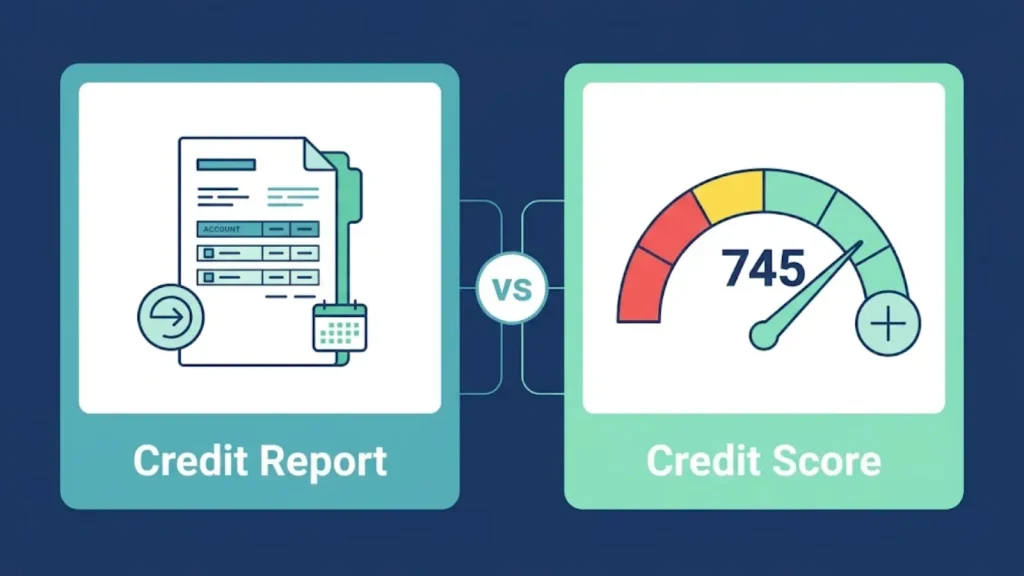
| Credit report | Credit score | |
|---|---|---|
| What it is | A record of accounts, balances, payment history, collections, public records and inquiries | A number (or category) predicting credit behavior |
| Who produces it | A credit bureau, from what creditors and others report to it | A scoring model, run on the data in one report |
| How many you have | Usually one per bureau; the CFPB notes creditors are not required to report to every bureau | Many: the CFPB says each score depends on the data, the model, the loan type and “even the day when it was calculated” |
| Can you dispute it? | Yes: the FCRA gives a right to dispute “the accuracy or completeness of any information” in a report | A bureau that distributes another company’s score is not required to process a dispute about that score (1681g(f)(5)) |
| Free by law? | Yes, on request, under 15 U.S.C. 1681j | Only in specific situations, listed below |
Is your credit score on your credit report?
Federal law does not require it to be. The FCRA’s file-disclosure section, which is what you receive when you ask a bureau for your report, says in 1681g(a)(1)(B): “nothing in this paragraph shall be construed to require a consumer reporting agency to disclose to a consumer any information concerning credit scores or any other risk scores or predictors relating to the consumer.”
Instead, the same section requires the bureau, when “the consumer requests the credit file and not the credit score,” to include “a statement that the consumer may request and obtain a credit score” (1681g(a)(6)). So a report that arrives without a score is the law working as written, not an omission.
Our reading: this is why two well-known explanations can seem to disagree. NerdWallet’s guide states flatly, “Your credit score does not appear on your credit reports.” That matches what the free file disclosure usually looks like, but the law does not forbid a bureau from showing a score; it only declines to require one.
Five routes by which the law gives you one or the other
This table is built from the statute and regulation sections we read. It answers a practical question: in what situation does each document reach you, and what does it cost?
| Situation | What you receive | Cost under the rule | Rule |
|---|---|---|---|
| You ask a nationwide bureau for your file | Your credit report (all information in the file), without any required score | Free once in any 12-month period from each nationwide bureau | 15 U.S.C. 1681j(a)(1)(A); 1681g(a)(1)(B) |
| You ask a bureau for your score | A score, its range, up to four key factors that hurt it (plus the number of inquiries, if that is also a key factor), the date it was created, and who provided it, plus a statement that a lender may use a different score | The bureau “may charge a fair and reasonable fee, as determined by the Bureau” | 15 U.S.C. 1681g(f)(1), (f)(8) |
| A lender takes adverse action (for example, denies credit) based on your report | Notice of the action, the numerical score it used, the score details above, the bureau’s contact details, and your right to a free report within 60 days | The follow-up report is free if requested within 60 days; the section sets no fee for the notice | 15 U.S.C. 1681m(a); 1681j(b) |
| You apply for a home loan secured by 1 to 4 residential units and the lender uses a score | The score and key factors, with a federally worded “notice to the home loan applicant” | The section sets no fee for the lender’s disclosure | 15 U.S.C. 1681g(g) |
| A lender sets your terms (such as the rate) using your report and offers terms less favorable than others get | Either a risk-based pricing notice, which must include the score used if one was used, or a credit score disclosure notice the lender gives instead | The sections set no fee for the notice | 12 CFR 1022.73(a)(1)(ix); 1022.74(d), (e) |
Three things stand out from reading the rules side by side.
The report is the document you can get on demand; the score mostly arrives because a lender used it. Three of the five routes start with a lender’s action, not your request.
The free report is a floor, and the FTC reports a wider program on top of it. The FTC’s page on free credit reports (dated June 2026) states: “All three nationwide credit bureaus have permanently extended a program that lets you check your credit report from each once a week for free at AnnualCreditReport.com.” The statute’s 12-month entitlement still stands underneath that program.
The score a lender shows you is the one it used, and the law says so. The home loan notice in 1681g(g) tells applicants the lender “must disclose to you the score that a consumer reporting agency distributed to users and the lender used in connection with your home loan.” A score from any other source may be a different model, run on a different day, on a different bureau’s data.
Why the number you see may not be the number a lender sees
A score requested from a bureau under 1681g(f) must come with “a statement indicating that the information and credit scoring model may be different than the credit score that may be used by the lender.” The CFPB’s page “Where can I get my credit scores?” (last reviewed October 15, 2026) adds that some sources provide an “educational” credit score, that “For most people, an educational score is similar to the scores lenders use,” and that “it’s normal to see credit scores that are slightly different.”
Our reading: when two numbers disagree, the report is the place to look, because both numbers are calculated from what the report says. A difference in reports between bureaus is its own question, and so is a difference in models.
What a score is made from, according to one model’s maker
Scoring models are owned by private companies, and the weights are theirs to publish. FICO’s own consumer education page, “What’s in your credit score?” (read November 11, 2026), groups the data into five categories: “payment history (35%), amounts owed (30%), length of credit history (15%), new credit (10%), and credit mix (10%).” The same page says “The importance of these categories may vary from one person to another,” and that FICO Scores are calculated only from credit report information, with one exception it names for a version that considers bank account data the consumer permits.
Those percentages are FICO’s description of FICO’s models, not a rule for every score. The CFPB’s list of factors “typically taken into account by credit scoring models” covers the same ground in general terms: bill-paying history, current unpaid debt, the number and type of accounts, how long they have been open, how much available credit is used, new applications, and collections, foreclosures or bankruptcies.
Every one of those inputs is something you can see on the report itself. Payment history, for instance, is built from whether payments were reported late, which depends on the reporting clocks described in when a payment is actually late.
Who uses which
The CFPB’s report page says lenders use reports to decide whether to lend and “what interest rates they will offer you,” and that insurers, landlords, utilities and, with your permission, employers may use them too. Its score page says companies use scores for credit decisions “as well as for tenant screening and insurance,” and to set “the interest rate and credit limit you receive.”
So both documents can affect the rate on a loan. How a rate turns into the interest you are actually charged is the arithmetic in how interest is calculated.
Who regulates this
Credit bureaus are consumer reporting agencies under the FCRA, and lenders that use their reports carry their own duties under it. Regulation V, which sets the risk-based pricing and credit score notice rules quoted above, is the CFPB’s regulation (12 CFR part 1022).
FAQ
Is a credit report the same as a credit score?
No. The CFPB describes them as two different things: the report is a statement of your credit activity and account status, and scores are calculated from the information in it.
Why didn’t my free credit report include a score?
Federal law does not require a bureau to include scores in the file it discloses to you. It requires the bureau to tell you that you can request a score, which it may charge a fee for.
When does a lender have to show me my credit score?
Under the rules read for this article: when it takes adverse action based on your report, when it uses a score on an application for a loan secured by a 1 to 4 unit home, and when it uses a score to set your terms: either in a risk-based pricing notice, if your terms are less favorable than others receive, or in a credit score disclosure notice, which a lender using that route gives to every applicant for that type of credit.
Can I dispute my credit score?
The FCRA dispute right covers the accuracy or completeness of information in your report. A bureau that distributes a score developed by another company is not required to process a dispute about that score, but must give you that company’s name, address and website. Our reading: since the score is calculated from the report, the report is where an error is corrected.
Do I have only one credit score?
No. The CFPB says each score depends on the data used, the scoring model, the type of loan it is built for, the data source and the day it was calculated.