
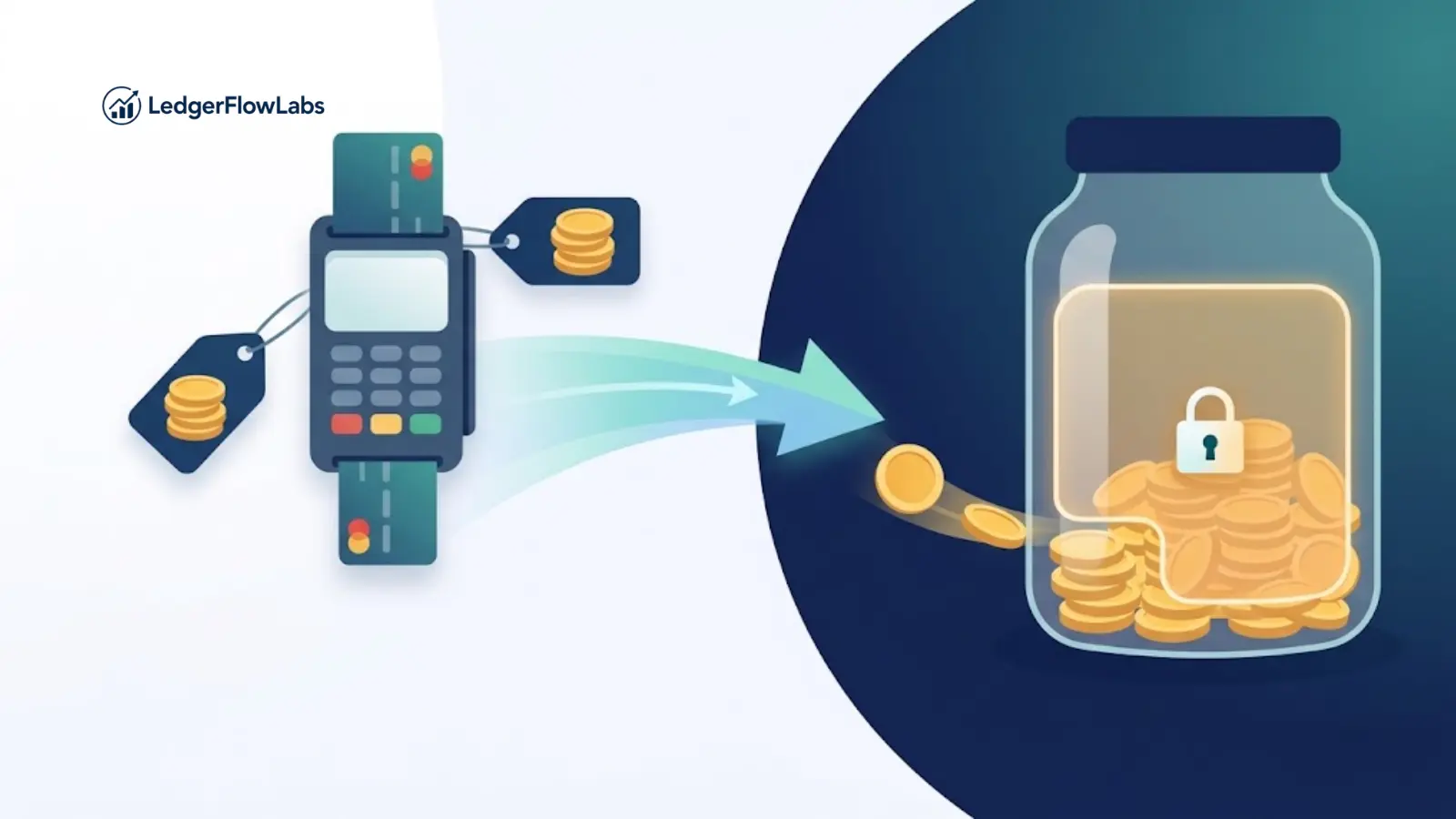
How do bank holds work? When you pay with a debit card, the merchant first asks your bank to approve an amount, and the bank sets that amount aside from your available balance. This is an authorization hold. If the merchant does not yet know the final price, as at a gas pump, a hotel or a rental car counter, it may ask for more than you end up spending. The money never leaves your account for the hold itself. It is simply unavailable until the merchant sends the final charge and the hold is released or replaced.
That is why a $30 fill-up can briefly lock up a much larger amount. The rest of this guide walks through each step, and why the timing matters most when a balance is low.
What a hold actually is
A hold is a note on your account, not a payment. It tells the bank: "this amount is spoken for, do not let it be spent on anything else."
Two different things get called a "hold," and they work differently:
| Type of hold | Who starts it | What it does |
|---|---|---|
| Authorization hold (merchant hold) | A merchant, when you pay by card | Sets aside the amount the merchant asked for until the final charge arrives |
| Deposit hold (check hold) | Your bank, when you deposit a check | Delays when deposited money becomes spendable |
This article is about the first kind: the hold a merchant places when you pay. Deposit holds follow separate federal timing rules and are about money coming in, not money going out.
The Georgia Attorney General's Consumer Protection Division describes the merchant kind simply. Its page on debit card holds (read September 27, 2026) says a hold "is placed on your account to cover the anticipated charges" and serves as "a means of assuring payment to the merchant."
How do bank holds work, step by step
Here is the sequence for a single debit card purchase.
- The card is used. At a register or a pump, the merchant sends an authorization request to your bank for a certain amount.
- The bank checks the available balance. If there is enough, or if the account has overdraft coverage that applies, the bank approves.
- The hold is placed. The approved amount is subtracted from your available balance right away. Your current balance, which counts only posted transactions, does not change yet.
- The merchant settles. Later, the merchant sends the final amount through the card network. This can take hours or days.
- The hold is replaced or released. The bank matches the final charge to the hold, posts the final amount, and releases whatever was held beyond it.
Step 3 is where the confusion starts. The available balance and the current balance now disagree, and they will keep disagreeing until step 5. The article on available balance vs actual balance goes deeper into why those two numbers drift apart.
Why the hold can be larger than what you spent
A hold is sized to what the merchant expects, not to what you end up buying. Some businesses cannot know the final number at the moment they ask for approval.
Gas stations. At the pump, the card is approved before any fuel flows. The station does not know whether the tank will take $15 or $90. So it asks for a set amount up front. The Georgia Attorney General's page says gas stations can place a hold on a card "for up to $175." Card networks set that ceiling, and it has changed over time, so the current figure for a specific card is something the bank can confirm.
Hotels. A hotel often asks for approval at check-in for the expected cost of the stay plus an extra amount for possible charges such as room service or damage.
Rental cars. Rental companies commonly hold an amount beyond the rental price to cover fuel, late return or damage.
Restaurants. A restaurant may request approval for the bill before a tip is added, and the final charge then comes through higher.
Here is how the gas example plays out. The figures are an illustration only, not a quote from any bank or station:
| Moment | Available balance | Current balance |
|---|---|---|
| Before fueling | $200 | $200 |
| Hold placed at pump for $175 | $25 | $200 |
| Final $30 charge posts, hold released | $170 | $170 |
For the period in the middle row, $145 that was never spent is unavailable. If another payment tried to come out at that moment, the account would look nearly empty.
Why a hold can look like a double charge
Sometimes the hold and the final charge appear on the account at the same time, briefly. A $175 pending line and a $30 posted line for the same station can make it look as if both were taken.
Usually, once the bank matches the final charge to the original authorization, the pending hold drops off. The guide to pending vs posted transactions explains why a pending amount can differ from the amount that finally posts, and why the two lines do not always match up right away.
When a hold does not drop off after the final charge posts, the bank's customer service is the place to ask. It can see whether the merchant's settlement matched the authorization.
How long a hold lasts
There is no single national clock for merchant holds. The length depends on the merchant, the card network and the bank's own processing.
The Georgia Attorney General's page says "the hold with the merchant generally lasts for not more than a day," but also that "some credit card companies allow up to three days for banks to clear transactions." Hotels and rental cars can take longer, since the final bill is not known until checkout or return.
Weekends and bank holidays can stretch things further, because settlement files are processed on business days. The bank's own account agreement or its customer service can say how long it keeps an unmatched authorization before releasing it.
Debit holds vs credit card holds
The mechanics are almost identical on a credit card. The difference is whose money is tied up.
- On a debit card, the hold reduces the available balance in a checking account. That is real money that bills, checks and automatic payments may be relying on.
- On a credit card, the hold reduces available credit. The checking account is not touched.
This is why a hold on a debit card carries a risk a credit card hold does not. The Georgia page notes that if a debit hold is not accounted for, "some checks could bounce even though the money is in the account to cover them."
When a hold meets a low balance
A hold is harmless when the account has plenty of room. It becomes a problem when the balance is thin and something else arrives during the hold window.
Picture the table above, but with an automatic bill of $60 scheduled for the same afternoon. With $25 available, the bill no longer fits, even though the account really has enough money once the hold is released. Depending on the bank's policy and the account's settings, that bill could be declined, returned, or paid into overdraft with a fee.
The Consumer Financial Protection Bureau heard this from consumers directly. In its data spotlight on consumer experiences with overdraft programs (read September 27, 2026), based on interviews and focus groups with 36 participants in summer 2022, some participants pointed to "gas station and rental car holds causing negative balances due to the delays in releasing these holds." The CFPB notes that the group was small and not representative of all consumers, but the pattern matches the mechanics above.
The piece on autopay overdraft risk shows how scheduled payments and temporary holds can collide on the same day.
What the Georgia consumer page lists as ways holds are reduced
The Georgia Attorney General's page lists several practices that affect how large or how long a hold is. Among them: using a PIN rather than a signature transaction, paying inside for gas when the pump has no PIN pad, presenting a credit card for multi-day hotel stays or car rentals, and asking the bank about its policy on the length of debit holds. Whether any of these fits a particular situation depends on the account and the card, and the bank can explain how its own processing treats each one.
Frequently asked questions
How do bank holds work on a debit card?
The merchant asks the bank to approve an amount, and the bank sets that amount aside from the available balance. The money is not taken yet. When the merchant sends the final charge, the bank posts it and releases any extra that was held.
Why did the gas station hold more than I spent?
The pump approves the card before any fuel is pumped, so the station does not know the final amount. It requests a set amount up front. The Georgia Attorney General's Consumer Protection Division page, read September 27, 2026, says gas stations can place holds of up to $175.
Does the merchant keep the extra money from a hold?
No. A hold only makes money unavailable. When the final charge posts, the amount held beyond it is released back to the available balance.
How long can a debit card hold last?
It varies by merchant, card network and bank. The Georgia Attorney General's page says merchant holds generally last no more than a day, but some take up to three days, and hotel or rental holds can run longer. The bank can confirm its own timing.
Can a hold cause an overdraft?
It can contribute to one. A hold lowers the available balance, so another payment arriving during the hold window may not fit. The CFPB's 2022 consumer research recorded people describing gas station and rental car holds leading to negative balances.