
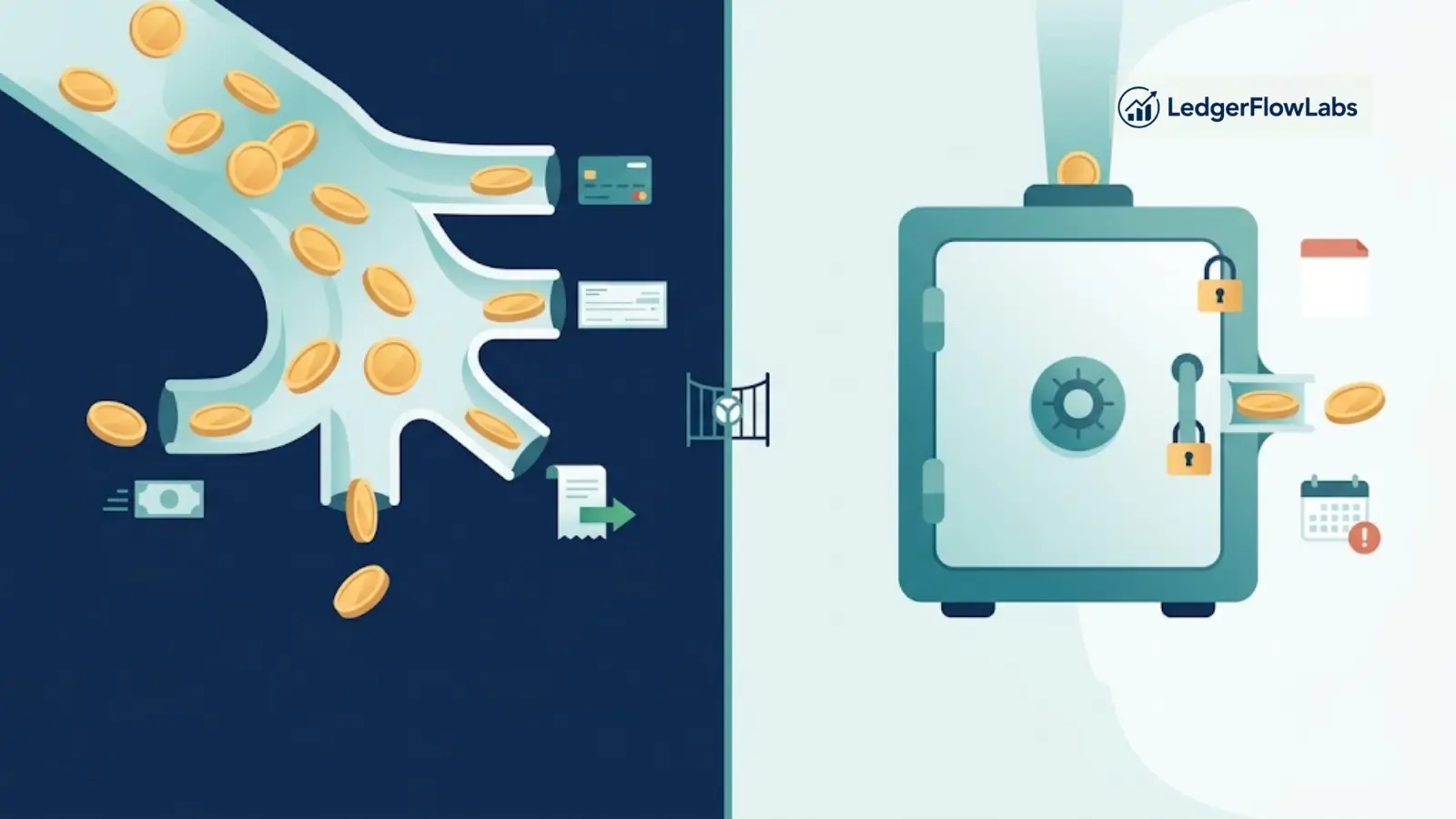
The real checking vs savings account difference is about how money is allowed to leave. A checking account is a transaction account: it is built so money can go out many ways, many times, including charges pulled by other people through a debit card, a check or an automatic bill payment. A savings account is legally a "savings deposit": fewer ways out, and a contract term that lets the bank require advance written notice before a withdrawal. Interest is a result of that structure, not the main difference.
Bank websites usually explain the two accounts by their purpose: one for spending, one for saving. That is true, but it is marketing language. Underneath it are rules that decide who can move your money, how often, and how fast. Those rules are what this guide walks through.
Two legal categories behind two familiar names
In the US, the words "checking" and "savings" are product names a bank chooses. The categories underneath them come from federal banking rules, mainly the Federal Reserve's Regulation D.
A transaction account is an account designed for payments to other people. Checking accounts are the everyday example. Money can leave by debit card, paper check, ATM, online bill pay, person-to-person transfer, or an ACH debit that a company sends to pull a payment.
A savings deposit has a narrower definition. Regulation D, at 12 CFR 204.2(d)(1), describes it as an account where the depositor "may at any time be required by the depository institution to give written notice of an intended withdrawal not less than seven days before withdrawal is made." We read that text on September 27, 2026.
That single clause is the most structural difference between the two accounts, and almost no one has heard of it. The next sections explain what it means in practice.
The checking vs savings account difference in how money leaves
The simplest way to see the difference is to ask one question about each account: who can start a withdrawal?
On a checking account, the answer is "you, and anyone you have authorized." That includes:
- A store, when you tap or swipe the debit card.
- Anyone you write a check to, when they deposit it.
- A company you gave your account and routing numbers to, when it pulls a bill payment.
- An ATM, when you withdraw cash.
On a typical savings account, the answer is usually just "you." Money mostly leaves by a transfer you start, often to your own checking account, or by a withdrawal at a branch or ATM. Many savings accounts do not come with checks, and some do not allow bill payments to be pulled from them directly. The exact list depends on the bank and is spelled out in its account agreement.
This is why overdrafts almost always happen in checking. A checking account lets other parties pull money on their own timing, so a charge can arrive when the balance is lower than expected. The article on autopay overdraft risk shows how that timing gap builds up. A savings account, with fewer outside parties able to pull from it, has less exposure to that kind of surprise.
The six-transfer limit: what changed in 2020
For decades, Regulation D limited certain convenient transfers and withdrawals from a savings deposit to six per month. That is where the familiar "six withdrawals" rule came from.
In April 2020 the Federal Reserve changed this. According to the Federal Reserve Board's Savings Deposits Frequently Asked Questions (read September 27, 2026), the rule change "permits depository institutions to suspend enforcement of the six-transfer limit, but it does not require depository institutions to do so."
Three points follow from that page:
- The federal limit is no longer required. A bank may let customers make unlimited convenient transfers from savings.
- A bank may still keep its own limit. Some banks continue to cap transfers, sometimes at six.
- Fees are the bank's call. The FAQ states that "Regulation D does not require or prohibit depository institutions from charging their customers fees for transfers and withdrawals in violation of the six-transfer limit."
So "savings accounts only allow six withdrawals a month" is no longer a federal rule. Whether a particular account still has a cap, and what happens if it is exceeded, is found in that account's own terms.
The seven-day notice clause most people never see
The same FAQ page adds that the "reservation of right" is still part of the definition of a savings deposit. That is the seven-day written notice clause quoted above.
In everyday banking it is rarely used. Most people move money out of savings the same day, and many never learn the clause exists. But it is written into the structure of the account. On a checking account, the bank has promised to pay on demand. On a savings account, the bank has kept the right to ask for notice first.
This helps explain why banks treat the two accounts differently. Money the bank can, at least in theory, ask you to give notice before withdrawing is more predictable money for the bank. That predictability is part of why savings accounts typically pay more interest than checking accounts.
Why interest usually differs
Interest is the part the marketing talks about most, so it is worth placing it correctly.
A checking account costs the bank more to run: card networks, check processing, fraud monitoring, bill pay, and a steady flow of transactions. Money in checking also tends to move in and out quickly. A savings account usually has fewer transactions and more stable balances.
Given those two shapes, banks generally pay little or no interest on checking and more on savings. Rates vary widely between banks and change over time, so no single rate describes either account. When a savings account advertises a return, it is usually stated as an APY. The guide to APR vs APY explains what that figure measures.
Some checking accounts do pay interest. They are still transaction accounts, with all the ways money can leave that come with that, and the rate paid on them is often low.
What stays the same across both accounts
For all the differences, a lot is shared:
- Deposit insurance. The FDIC's page on understanding deposit insurance (read September 27, 2026) lists both checking accounts and savings accounts as covered deposits, up to "$250,000 per depositor, per FDIC-insured bank, for each account ownership category." Checking and savings at the same bank, in the same ownership category, are added together toward that limit.
- Direct deposit. Either account can usually receive a paycheck.
- Statements. Both produce a periodic statement showing deposits, withdrawals, fees and interest.
- Fees. Either can carry a monthly fee or a minimum balance requirement, depending on the bank.
Side by side: checking vs savings
| Feature | Checking (transaction account) | Savings (savings deposit) |
|---|---|---|
| Built for | Payments out, often many per month | Holding money with fewer movements |
| Who can start a withdrawal | You, plus merchants, check payees and billers you authorize | Mostly you |
| Debit card and checks | Usually included | Often not included |
| Transfer limits | None under federal rules | No federal cap since 2020; a bank may set its own |
| Seven-day notice clause | Not part of the definition | Part of the definition, rarely used |
| Interest | Often none or low | Usually higher than checking, varies by bank |
| Overdraft exposure | Higher, since others can pull money | Lower |
| Deposit insurance | Covered | Covered |
How the two work together in practice
Because of those rules, many people end up using the two accounts for different jobs. Checking handles the flow: paychecks in, bills and purchases out. Savings holds money that is not meant to move often.
That split lines up with two kinds of saving discussed on this site. The piece on sinking funds vs emergency funds explains the difference between money set aside for a known future bill and money held for the unexpected. Where each one is kept is a personal decision, and the account structure described above is one of the things that shapes it.
One more link between the two accounts is common. Many banks offer to connect a savings account to a checking account so that money moves automatically if checking runs short. Whether that transfer carries a fee, and how it counts against any savings transfer limit, depends on the bank's own terms.
Finding out which rules your own accounts follow
Every account comes with disclosures that answer the questions in this guide. Under the federal Truth in Savings Act, banks disclose the interest terms and fees on deposit accounts. The documents to look at are:
- The account agreement, for how withdrawals and transfers work and any transfer limit.
- The fee schedule, for charges such as excess withdrawal fees.
- The rate sheet or disclosure, for the current interest rate and APY.
If something in those documents is unclear, the bank's customer service is the place to ask for the answer in writing.
Frequently asked questions
What is the main checking vs savings account difference?
The main difference is how money is allowed to leave. Checking is a transaction account that lets you and others you authorize, such as merchants and billers, pull money out many times. Savings is a savings deposit with fewer ways out, and its legal definition lets the bank require written notice before a withdrawal.
Do savings accounts still have a six-withdrawal limit?
Not as a federal requirement. The Federal Reserve's Savings Deposits FAQ, read September 27, 2026, says banks are permitted but not required to suspend the six-transfer limit. Some banks still set their own limit or charge fees for extra withdrawals, which appears in the account's terms.
Can a bank really make me wait seven days to withdraw from savings?
The definition of a savings deposit in Regulation D includes the bank's right to require at least seven days' written notice before a withdrawal. Banks rarely use it in everyday practice, but it remains part of the account's legal structure.
Are checking and savings accounts insured the same way?
Yes. The FDIC lists both as covered deposits. Balances in the same ownership category at the same bank are added together toward the standard limit of $250,000 per depositor, per bank, for each account ownership category, according to the FDIC's page read September 27, 2026.
Why does checking pay less interest than savings?
Checking accounts cost more to run because of card, check and payment processing, and their balances move in and out quickly. Savings balances tend to be steadier. Banks generally price that difference into the interest they pay, though rates vary by bank.