
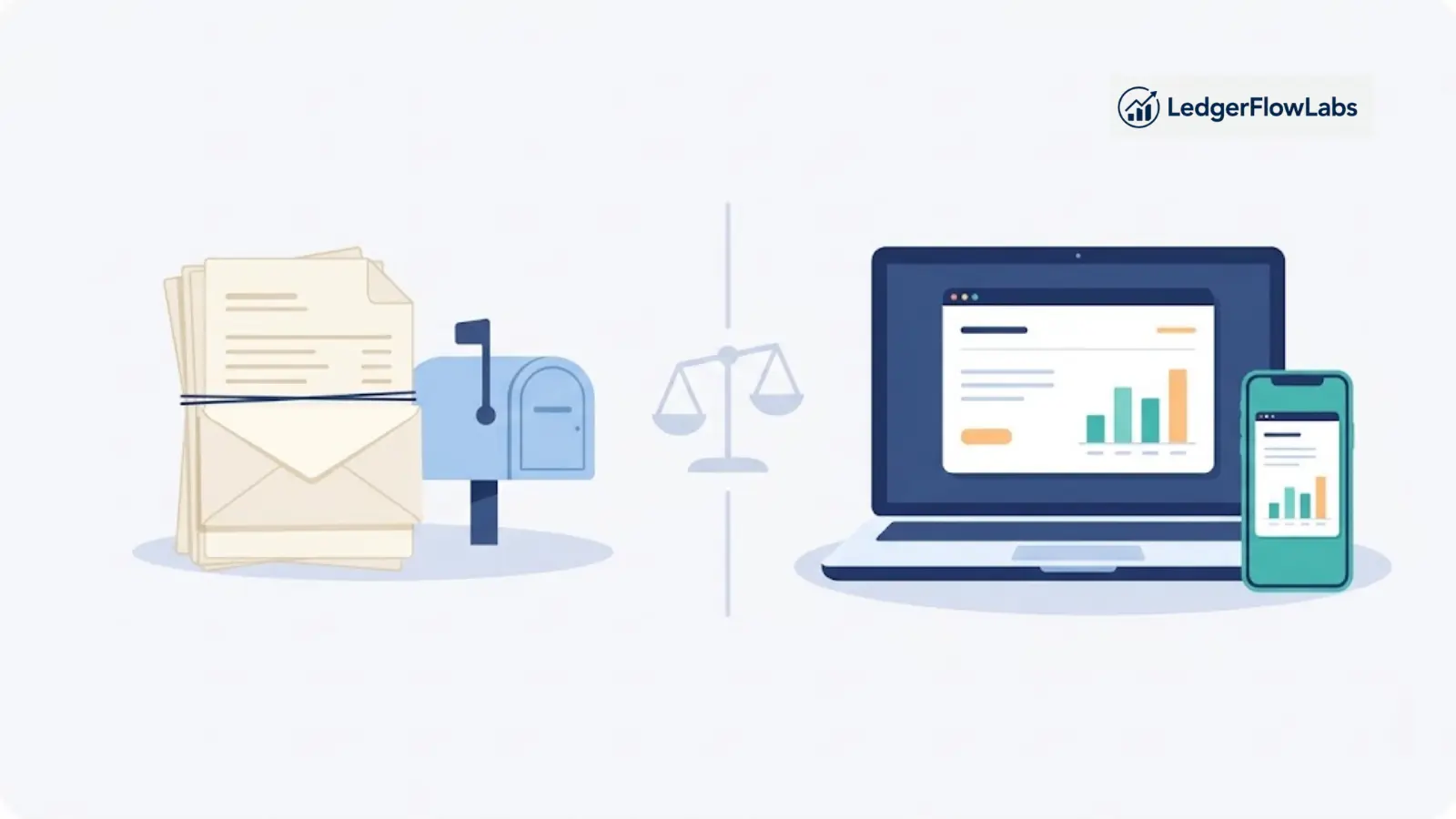
Paperless statements pros and cons come down to one idea: the statement itself does not change, only how it reaches you and who keeps the copy. An electronic statement carries the same balances, fees and due date as the paper one. The practical gains are faster access, less mail and sometimes no paper fee. The practical costs are that nothing lands on the table as a reminder, and older statements may only stay online for a limited time. In the US, a bank or card issuer needs your consent before switching you to electronic delivery.
Where this applies: banks, credit unions and card issuers in the United States. The federal rules below apply nationwide. Fees for paper statements and some record rules can vary by institution, by account type and by state, so the details for a specific account are in its own terms, and a state's banking regulator can say what applies locally.
This article explains how statement delivery works. It is general information, not financial or legal advice.
What stays exactly the same
It helps to start with what does not change, because the push to go paperless can make it sound bigger than it is.
- The content. The same transactions, balances, fees, interest lines and minimum payment appear either way.
- The due date. Switching delivery does not move a payment due date.
- The timing rule for credit cards. The CFPB's published text of Regulation Z, section 1026.5, read on September 27, 2026, says card issuers must have "periodic statements … mailed or delivered at least 21 days prior to the payment due date disclosed on the statement." The words "mailed or delivered" cover both paper and electronic statements, so the 21-day window does not shrink when the statement goes electronic.
- The disclosures. The same section allows required disclosures "in electronic form, subject to compliance with the consumer consent and other applicable provisions" of the federal E-Sign Act. Electronic delivery is allowed, but only on the E-Sign Act's terms.
What the consent screen has to tell you
This is the part most pros-and-cons lists leave out. Under federal law, going paperless is not something a bank can simply announce. The consent step has required contents, and reading them tells you most of what will change for that account.
The federal E-Sign Act, published at 15 U.S.C. 7001 on GovInfo and read on September 27, 2026, says that when a law requires information to be given to a consumer in writing, an electronic version counts only if "the consumer has affirmatively consented to such use and has not withdrawn such consent." Before consenting, the consumer must receive a clear and conspicuous statement covering:
- The right to paper. "any right or option of the consumer to have the record provided or made available on paper or in nonelectronic form, and the right of the consumer to withdraw the consent."
- The scope. Whether the consent covers only one transaction or whole categories of records during the relationship.
- How to withdraw. "the procedures the consumer must use to withdraw consent" and how to update contact details.
- Paper copies and fees. "how, after the consent, the consumer may, upon request, obtain a paper copy of an electronic record, and whether any fee will be charged."
The law also requires a statement of "the hardware and software requirements for access to and retention" of the records, and consent given "in a manner that reasonably demonstrates that the consumer can access information in the electronic form."
Put simply, the consent screen is a short checklist. It says whether paper can come back, how to switch back, whether a paper copy later costs anything, and which records the switch covers. Those four answers are the real terms of going paperless for that account.
The pros, in practice
Faster access and nothing lost in the mail
An electronic statement is usually available in the online account or app as soon as it is generated, instead of arriving days later by post. There is no envelope to go missing and no statement sitting at an old address after a move.
Searchable records
A PDF statement can be downloaded, searched and filed. Finding a particular charge from several months back is often faster than digging through a drawer. That also makes tracking spending across months easier; reading your own cash flow across three months uses exactly this kind of statement history.
Sometimes lower cost
Some institutions charge for paper statements and not for electronic ones. The E-Sign Act does not ban paper fees, but it does require the consent statement to say "whether any fee will be charged" for a paper copy after consent. Whether a given account carries a paper fee, and how much, is in that account's fee schedule.
Less paper to store and shred
Fewer printed statements means fewer documents with account numbers to store securely and eventually destroy.
The cons, in practice
No physical reminder
A paper statement on the counter is a prompt to look at it. An email notice is easier to archive without opening, and some notices do not include the balance or due date at all, only a message that a statement is ready. That is the most common way a switch to paperless ends in a missed payment. A written list of due dates, like the one in how to make a bill calendar, does the reminding job the envelope used to do.
The online archive may have a limit
Online statement history is kept for a period the institution chooses, and older statements may not stay available forever. Once an account is closed, online access to its statements may end as well. Anyone who needs a long record, for taxes, a dispute or a loan application, depends on having saved copies before that window closes.
Access depends on the account login
If a password is lost, an email address changes, or an app is updated in a way that no longer runs on an older phone, statements can become harder to reach. This is why the E-Sign Act requires the hardware and software requirements to be stated up front.
Email notices can be imitated
A real "your statement is ready" email looks a lot like a fake one. Fraudsters copy these notices to collect login details. Going straight to the institution's app or typing its web address, rather than following a link in an email, avoids that risk.
Paper vs paperless, side by side
| Paper statement | Electronic statement | |
|---|---|---|
| Content | Full statement | Same full statement |
| Credit card delivery timing | At least 21 days before the due date | Same rule, "mailed or delivered" |
| How you are alerted | The envelope arrives | An email or app notice, sometimes without the amount |
| Where the copy lives | With you | With the institution, until downloaded |
| How long it stays available | As long as it is kept | The institution's online retention period, unless saved |
| Cost | May carry a fee at some institutions | Usually no delivery fee |
| Switching back | Not applicable | The consent statement must explain how |
Things to check before and after switching
A short list of what to look at, whatever the decision:
- The consent screen's four answers: right to paper, scope, how to withdraw, and any fee for paper copies later.
- What the notice email contains. Some show the balance and due date; others only a link.
- How far back online statements go, and whether access continues after an account closes.
- Autopay interaction. Paperless and autopay are often offered together, but they are separate settings. Automatic payments carry their own timing risks, covered in autopay overdraft risk.
- The due date itself, which stays the same either way. When a payment is actually late explains how the due date and cutoff time work.
Frequently asked questions
Can my bank switch me to paperless statements without asking?
Under the federal E-Sign Act, an electronic record replaces a legally required written one only if the consumer has "affirmatively consented" and has not withdrawn that consent. The consent must come after a clear statement of the right to paper and how to withdraw.
Can I switch back to paper statements later?
The E-Sign Act requires the consent statement to explain "any right or option" to receive records on paper, the right to withdraw consent, and the procedure for doing it. The specific steps for an account are in that consent statement or the account terms.
Do paperless credit card statements change my due date?
No. Regulation Z requires card statements to be "mailed or delivered at least 21 days prior to the payment due date," which covers electronic delivery too. The due date on an electronic statement is the same one a paper statement would show.
Can a bank charge a fee for paper statements?
The E-Sign Act does not ban paper fees, but it requires the consent statement to say whether any fee will be charged for a paper copy after consent. Fees and any limits on them depend on the institution, the account type and, in some cases, the state, so the account's own fee schedule is the place to check.