
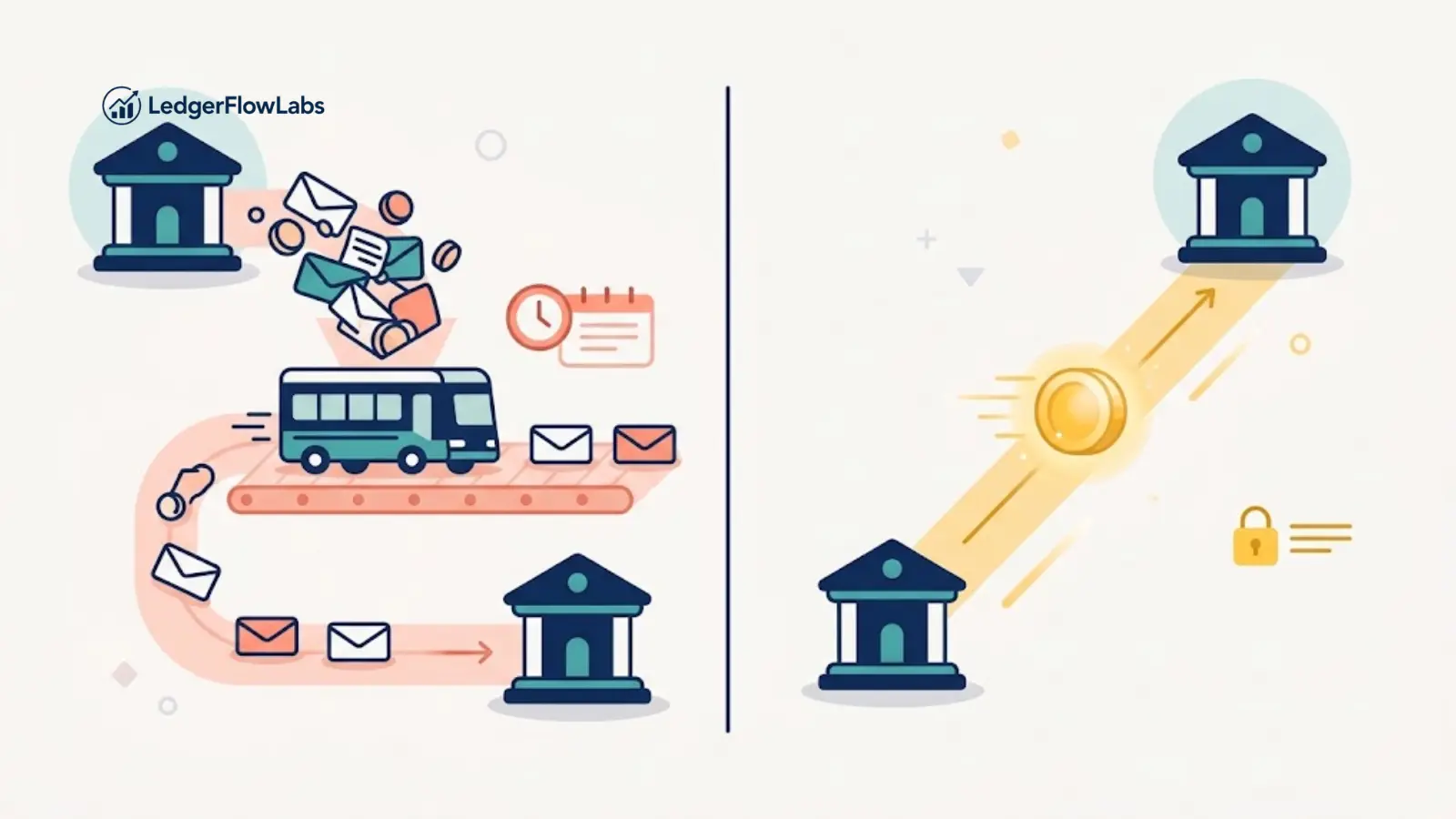
The main ACH vs wire transfer difference is how the money travels. An ACH transfer is grouped with many others into batches and settled at set times, so it usually takes one or more business days and can sometimes be reversed. A wire transfer is sent and settled one payment at a time, so it usually arrives the same business day and is treated as final once it lands. A card payment works differently again: it is approved in seconds but settles later.
Those three routes explain most of the "why is this one instant and that one taking three days?" questions people have when they look at a bank account. The rest of this guide walks through each route, what "arrived" actually means for each, and which rules apply when something goes wrong.
Three questions that separate the routes
Speed is the part everyone notices, but it is really three separate questions:
- When does the money look like it moved? This is what the app shows.
- When is it settled? This is when the banks have actually squared up with each other.
- Can it be undone? This is whether a mistake or a fraud can be pulled back, and under which rules.
The three routes give different answers to all three.
| ACH transfer | Wire transfer | Card payment | |
|---|---|---|---|
| How it travels | In batches with other payments | One payment at a time | Approved first, settled later in a batch |
| When it looks moved | When the batch is processed, often a business day or more | Usually within the same business day | Instantly, as a pending charge |
| When it is settled | When the batch settles | When it is credited to the receiving bank | When the merchant settles, often a day or more later |
| Can it be undone | Some ACH debits can be disputed or returned | Very hard once sent | Card disputes exist, under separate rules |
| Common everyday uses | Paychecks, bill autopay, bank-to-bank transfers | Home closings, large or urgent payments | Shopping in stores and online |
The rows are general patterns. Exact timing depends on the bank, the time of day the payment is sent, weekends and holidays, and the specific service used.
How an ACH transfer moves
ACH stands for Automated Clearing House. It is the US network that carries most routine electronic payments between bank accounts: direct deposit of pay, automatic bill payments, and many transfers between an account at one bank and an account at another.
The key word is batch. A bank does not send each ACH payment on its own. It collects the day's payments and sends them in groups at scheduled times, and the receiving banks process those groups on their side. The Federal Reserve's assessment of the Fedwire Funds Service against payment-system core principles (revised July 2014; read September 28, 2026) draws the same contrast from the central bank's side: debits and credits from "check and automated clearinghouse (ACH) activity, are captured periodically throughout the day," while wires are handled one by one.
Batching is why ACH is cheap and reliable for high volumes, and why it is not instant. Same-day ACH options now exist, so some ACH payments settle within the same business day, but the payment still waits for a scheduled window.
Timing on the receiving side matters too. A paycheck sent by ACH can land on a different weekday from one month to the next because of cut-off times and holidays. The guide on how long a direct deposit takes to clear covers that in detail.
How a wire transfer moves
A wire transfer sends one payment from one bank to another on its own. In the US, domestic wires between banks commonly run over the Federal Reserve's Fedwire Funds Service.
The same Federal Reserve document describes Fedwire as a system that "processes and settles payment orders individually throughout the operating day." It also states when a wire becomes final: payment is "final and irrevocable when the amount of the payment order is credited to the receiving participant's account or when the payment order is sent to the receiving participant, whichever is earlier."
That is why a wire is fast, and also why it is hard to undo. Once it is settled, the receiving bank has the money in final form. Pulling it back usually depends on the receiving bank and the recipient cooperating, not on a right the sender holds.
Banks usually charge a fee to send a wire, and some charge to receive one. Fees differ widely by bank and account type, so the bank's own fee schedule is the place to check the current amount.
How a card payment moves
A card payment is a two-step process, and that is the source of a lot of confusion.
Step one is authorization. At the register or checkout, the card network asks the bank whether the purchase is approved. If it is, the bank places a hold for that amount. This takes seconds and shows up as a pending charge.
Step two is settlement. Later, often at the end of the merchant's business day, the merchant sends the final amount and the payment settles. Only then does it post to the account. The final amount can differ from the pending one, which is common at gas stations, hotels and restaurants where a tip is added.
So a card payment looks instant from the shopper's side but, underneath, it is closer to a batch system than a wire. The article on pending vs posted transactions explains why a pending charge can sit for several days before it posts, and the guide to available balance vs actual balance shows how those holds change the number the bank uses.
The ACH vs wire transfer difference when something goes wrong
This is the part that matters most and gets the least attention: the consumer protections are not the same.
ACH and debit card transfers made by a consumer from a personal account generally fall under the federal Electronic Fund Transfer Act and its Regulation E. That rule set covers things like error resolution and limits on a consumer's liability for unauthorized transfers, with conditions and deadlines spelled out in the regulation.
Wires are largely outside that rule set. The Consumer Financial Protection Bureau's text of Regulation E, section 1005.3 on coverage (read September 28, 2026) excludes "any transfer of funds through Fedwire or through a similar wire transfer system that is used primarily for transfers between financial institutions or between businesses."
Instead, domestic wires are governed mainly by Article 4A of the Uniform Commercial Code, which US states adopt into their own law, and by the bank's funds-transfer agreement. For Fedwire itself, the Federal Reserve's assessment notes that its Regulation J "adopts article 4A of the Uniform Commercial Code." Because the underlying law is adopted state by state and bank agreements differ, the specific rights that apply to one wire depend on the bank, the agreement and the state.
International wires sent by consumers are a separate case. The CFPB's answer page "What is a wire transfer?" (last updated October 10, 2024; read September 28, 2026) says wires sent from the US to other countries through a remittance transfer provider are "remittance transfers," which come with their own federal consumer protections.
Credit and debit card disputes follow separate rules again, depending on whether the card is credit or debit, and on the card network's own dispute process.
For any problem with a wire, the CFPB's same answer page says to "contact the company right away and explain the issue," and notes that a complaint can also be submitted to the CFPB.
Why a scam so often asks for a wire
Because a settled wire is final and outside Regulation E, it is the payment route fraudsters prefer. Common patterns include an urgent email claiming a home closing's wiring instructions have changed, or a caller claiming to be from a bank's fraud department asking for money to be moved "to a safe account."
A few checks cost nothing and happen before any money moves:
- Confirm wiring instructions by phone, using a number from an independent source such as a prior statement or the organization's official website, not one from the email.
- Treat any last-minute change to account or routing numbers as a warning sign.
- Remember that banks do not ask customers to move money to a new account to protect it.
If a wire has already gone to the wrong place, speed matters, because the sending bank can only ask the receiving bank to return it while the money is still there.
Reading each route on a statement
Each route leaves a slightly different trail on a bank statement:
- ACH lines often show the company name, a word like "ACH", "PPD" or "DIRECT DEP", and sometimes a company ID.
- Wires usually appear as "WIRE OUT" or "WIRE IN", often with a reference number and a separate fee line.
- Card payments show the merchant name, sometimes in a shortened or processor form, and a posting date that can be a day or more after the purchase date.
When the date on the statement does not match the day you paid, the route usually explains it. A card purchase from Friday that posts on Monday, or an ACH bill payment that shows up a business day after it was scheduled, is the batch process doing what it was built to do. That same gap is why scheduled payments sometimes land at an awkward moment, which the piece on autopay overdraft risk covers.
Frequently asked questions
What is the main ACH vs wire transfer difference?
ACH payments are processed in batches at scheduled times, so they usually take one or more business days. Wires are processed one at a time and usually arrive the same business day. Wires are generally final once settled, while some ACH debits can be disputed or returned.
Why is a wire transfer so hard to reverse?
The Federal Reserve describes Fedwire payments as final and irrevocable once credited to the receiving bank. After that, getting money back usually depends on the receiving bank and recipient cooperating.
Is a wire transfer covered by Regulation E?
Generally no. Regulation E excludes transfers through Fedwire or similar wire systems used mainly between financial institutions or businesses. Domestic wires fall mainly under state law based on UCC Article 4A. International consumer wires can be remittance transfers with separate federal protections.
Is a card payment an ACH transfer?
No. A card payment runs over a card network. It is approved in seconds as a pending charge and settles later when the merchant submits the final amount.
Why does an ACH transfer take longer on a holiday?
ACH batches are processed on business days. A transfer sent late in the day, on a weekend or on a bank holiday usually waits for the next processing window.