
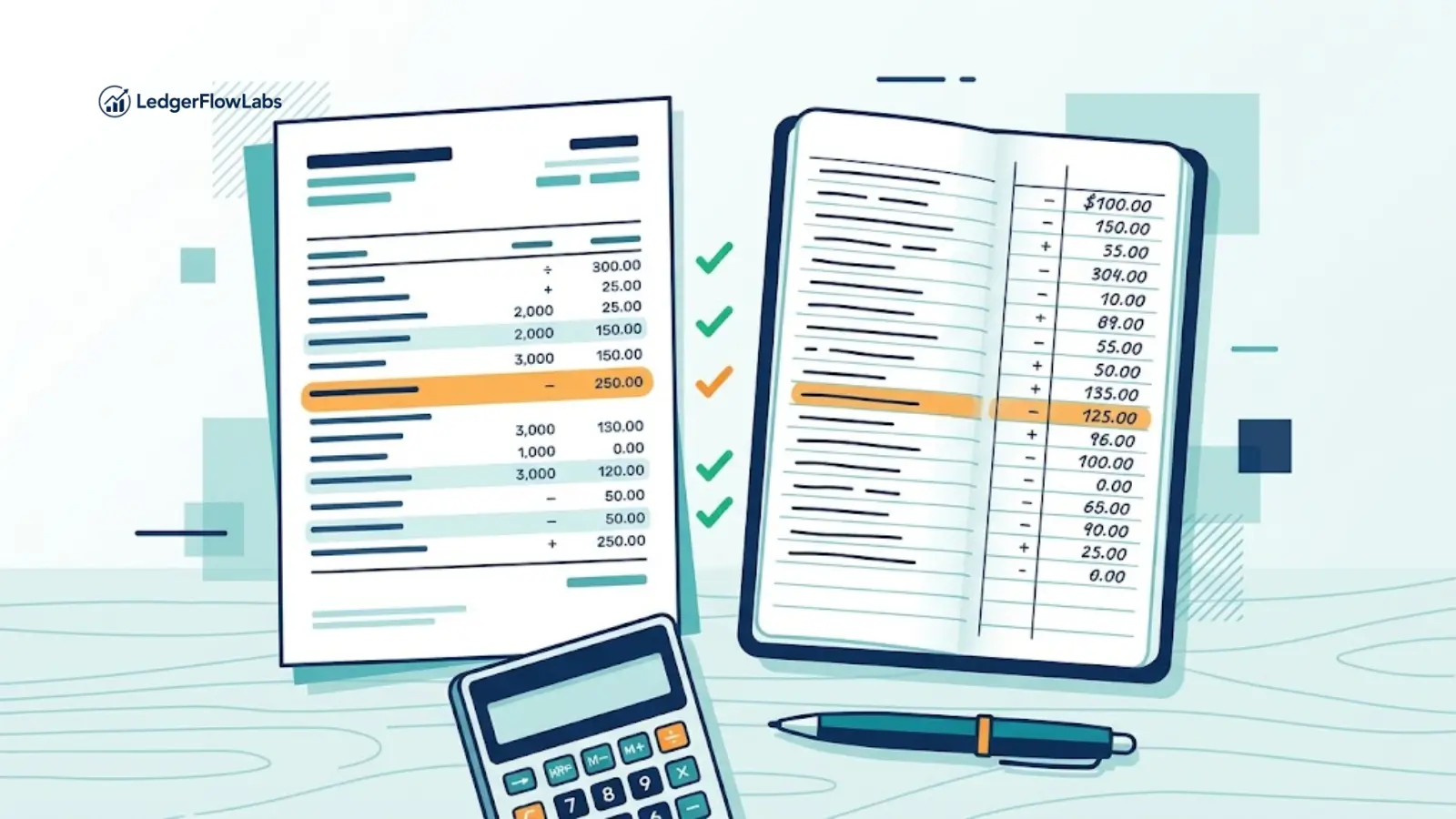
Here is how to reconcile a bank statement for a personal account. Start with the ending balance printed on the statement. Add any deposits you recorded that the bank has not shown yet, and subtract any checks, card purchases or withdrawals you recorded that have not reached the statement. Then update your own records with anything the bank shows that you missed, such as a fee or interest. If both adjusted numbers match, the month is reconciled. If they do not, the difference itself usually points to the line that is wrong.
Where this applies: personal checking and savings accounts at US banks and credit unions. The federal error rules quoted below come from Regulation E, which covers electronic transfers.
This article explains a record-keeping method. It is general information, not financial or legal advice.
What reconciling actually means
Reconciling is comparing two lists of the same money and explaining every difference between them. One list is the bank's: the statement. The other is yours: a check register, a notebook, a spreadsheet or a budgeting app where you wrote down what you spent and received.
The two lists almost never agree on the first try, and that is normal. The FDIC's Money Smart podcast episode "Balance Your Checkbook" (read on September 25, 2026) walks through exactly this situation and names the usual causes: a mailed check the payee has not deposited yet, a deposit made after the statement closed, an after-hours ATM transaction, a recurring payment that was forgotten, a fee you did not know about, and interest you could not have known in advance. None of those are mistakes. They are timing.
The goal of reconciling is to separate timing differences, which fix themselves, from real errors, which do not.
What you need before you start
Gather three things:
- The statement for one closed period, paper or downloaded. Use a closed statement, not the live app screen, because a statement has a fixed start and end date.
- Your own record for the same dates. Any format works as long as each entry has a date, a description and an amount.
- A pencil or a blank spreadsheet column for check marks.
Many paper statements carry a balancing worksheet on the back. The FDIC episode points to that worksheet as the place to start. If yours does not have one, the steps below do the same job.
How to reconcile a bank statement personal account, step by step
Step 1: Match the lines that appear in both places
Go down the statement one line at a time. For each deposit, check, card purchase, transfer and withdrawal, find the same item in your record and put a check mark next to it in both places. Match on amount first, then date, then description. The description is often the least helpful field, because merchant names on statements are frequently shortened or written as a legal company name.
Step 2: List what is only in your record
Anything in your record with no check mark after Step 1 is "outstanding." It happened on your side but had not reached the bank by the statement's closing date. Sort these into two groups:
- Deposits in transit: money you put in that the statement does not show yet.
- Outstanding withdrawals: checks not yet cashed, card purchases still pending, and scheduled payments that had not gone out.
A card purchase that was pending on the closing date is the most common item in this group. Pending vs posted transactions explains why a purchase can sit in one state before moving to the other.
Step 3: List what is only on the statement
Anything on the statement with no check mark belongs to the bank's side only. Typical examples are monthly service fees, ATM fees, overdraft fees, interest earned, and automatic payments you forgot to write down. These are not outstanding. They already happened, so they go into your record now.
Step 4: Adjust the bank's number
Take the statement's ending balance, add the deposits in transit, and subtract the outstanding withdrawals. The result is what the bank's balance would be if every item you know about had already arrived.
Step 5: Adjust your number
Take your record's balance, subtract the fees you just found, and add any interest or deposits you had not recorded. The result is what your balance would be if you had known everything the bank knew.
Step 6: Compare
If the two adjusted numbers match, the period is reconciled. Note the date and the balance at the bottom of your record so next month starts from a confirmed number.
A worked example with invented numbers
The numbers below are made up for illustration only. They do not describe any real account or any real bank's fees.
| Bank side | Amount |
|---|---|
| Statement ending balance | $1,240.50 |
| Add: deposit in transit | +$300.00 |
| Subtract: outstanding check #214 | -$85.00 |
| Subtract: card purchase still pending | -$42.30 |
| Adjusted bank balance | $1,413.20 |
| Your side | Amount |
|---|---|
| Balance in your own record | $1,424.70 |
| Subtract: service fee shown on statement, not recorded | -$12.00 |
| Add: interest shown on statement, not recorded | +$0.50 |
| Adjusted balance in your record | $1,413.20 |
Both sides land on $1,413.20, so the month reconciles. Notice that the bank's raw ending balance and your raw balance were $184.20 apart before any adjustment, and not one of those dollars was an error. It was all timing and two small items that had not been written down.
This is also why the balance in a banking app can mislead. The app shows the bank's side in real time, but it cannot see the check you mailed yesterday. Available balance vs actual balance covers how those two figures are built.
When the numbers still do not match: three arithmetic clues
This is the part most guides skip. When the adjusted balances disagree, calculate the difference and look at the number itself before rechecking every line. Three patterns cover most cases.
Clue 1: The difference equals one transaction
If the gap is exactly the amount of a single entry, that entry was probably missed on one side or counted twice. Search both lists for that exact amount.
Clue 2: The difference is exactly double one transaction
If the gap is twice the amount of an entry, the entry was probably recorded in the wrong direction: a withdrawal written as a deposit, or the reverse. Recording $40 as money in instead of money out moves the balance by $80, not $40.
Clue 3: The difference divides evenly by 9
If the gap divides by 9 with nothing left over, look for two digits written in the wrong order. Writing $54.00 when the real amount was $45.00 creates a difference of $9.00. Writing $315 instead of $351 creates a difference of $36, which is 9 times 4. Swapping two neighboring digits always produces a difference that divides by 9, which makes this a quick test before a full search.
If none of these fit, the cause is usually two or more small problems together. Re-run Step 1 carefully, and check the starting balance too: if last month was never reconciled, this month inherits its gap.
What reconciling catches that matters most
Most differences turn out to be your own record-keeping, and fixing them is simply updating your list. The reason the habit matters is the small share that are not.
The CFPB's published text of Regulation E, section 1005.11, read on September 25, 2026, lists what counts as an "error" on an electronic transfer. The list includes "an unauthorized electronic fund transfer," "an incorrect electronic fund transfer to or from the consumer's account," "the omission of an electronic fund transfer from a periodic statement," and "a computational or bookkeeping error made by the financial institution." It also covers a request for "additional information or clarification" about a transfer.
Each of those is something a monthly reconciliation is built to surface: a line you did not make, an amount that differs from your receipt, a deposit that never appeared.
The same section says the consumer's notice must reach the bank "no later than 60 days after the institution sends the periodic statement" that shows the problem. The FDIC episode makes the same point in plain words: tell the bank no later than 60 days after the date of the statement to be fully protected. It also suggests putting the concern in a letter that includes your name, account number, an explanation, the dollar amount and the date, and keeping a copy.
That 60-day clock is the practical reason to reconcile every month rather than every few months. A statement reviewed late can fall outside the window.
Two limits on that rule are worth knowing. Regulation E covers electronic transfers, such as debit card purchases, ATM withdrawals, direct deposits and online transfers. Paper checks are handled under the account agreement and state law, so the window for a problem with a check can be different; the deposit account agreement states which rules apply to that account. And a charge that looks unauthorized has its own reporting process at each bank, which starts with contacting the bank directly.
Making it a habit that takes minutes
Reconciling is slowest the first time and quickest when it happens every month, because each month starts from a confirmed number. A few habits keep it short:
- Record items as they happen, including small card purchases and transfers between your own accounts.
- Reconcile soon after the statement closes, while receipts are easy to find.
- Keep a short list of recurring items (subscriptions, automatic bill payments, the monthly service fee if your account has one) so they are never a surprise.
- Carry outstanding items forward. A check outstanding this month should appear on next month's statement. If it still does not, that is worth noticing.
The reconciled balance also feeds straight into a monthly budget check. What to do at the end of month one shows how a confirmed balance fits into a wider review, and how to read your own cash flow across three months builds on several reconciled months to show patterns a single statement cannot.
Frequently asked questions
How often should a personal bank account be reconciled?
Monthly, right after each statement closes, is the common rhythm because each statement covers one fixed period. It also keeps each review inside the 60-day window that Regulation E sets for reporting errors on electronic transfers.
Do I need to reconcile if I check my banking app every day?
The app shows only the bank's side. It cannot show a check you mailed, a deposit you made after hours, or an entry the bank recorded incorrectly that you never compared to a receipt. Reconciling compares the bank's list against yours, which daily glances do not do.
What if my statement balance is higher than my records?
That is usually timing. Checks you wrote or card purchases still pending have left your record but not the bank's yet, so the bank shows more money than you really have to spend. The adjustment in Step 4 accounts for this.
What should I do if I find a transaction I did not make?
Contact the bank directly and follow its process for disputed transactions. For electronic transfers, Regulation E requires the notice to reach the bank no later than 60 days after it sent the statement showing the problem, so raising it promptly matters.
Can I reconcile in a spreadsheet instead of a check register?
Yes. Any record with dates, descriptions and amounts works. A spreadsheet makes Clue 3 easy to test, since a single formula shows whether the difference divides evenly by 9.