
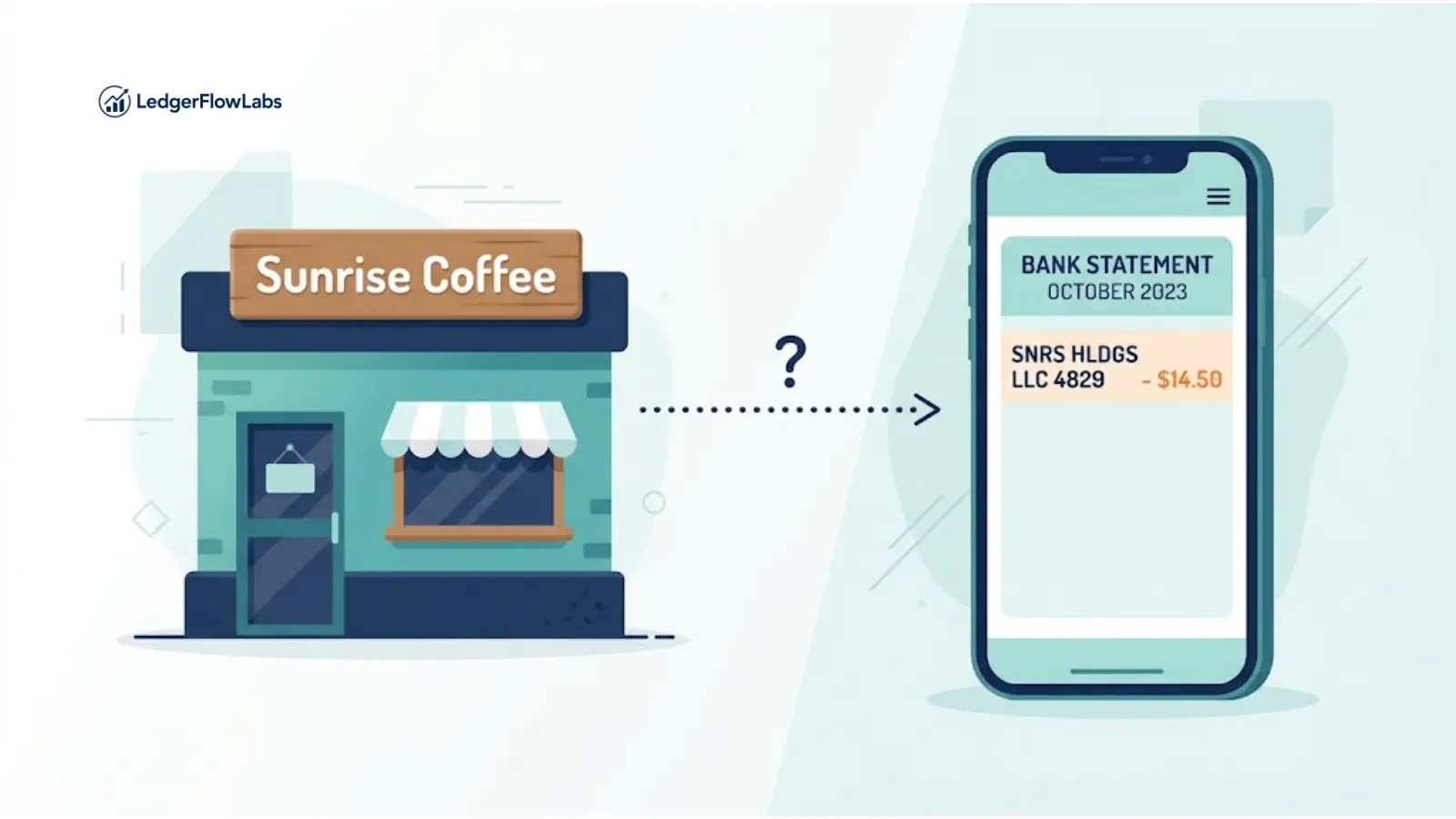
The question "why is merchant name different on statement entries?" has a short answer. The name on a bank or card statement is not copied from the shop's sign. It is a short text label, usually called a statement descriptor, that the business sets up with its payment processor. It often carries the business's legal or parent-company name, sometimes has the processor's own prefix in front, and is cut down to fit a small character limit. Then the bank or card issuer decides how to display it. Each step can move the name further from the one on the door.
Where this applies: debit and credit card statements from US banks and card issuers. The federal rules quoted below are Regulation Z (credit cards) and Regulation E (debit cards and other electronic transfers). How a specific bank displays names is its own choice within those rules.
This article explains how statement entries are labeled. It is general information, not financial or legal advice.
Where the name on a statement actually comes from
A card purchase passes through several hands before it becomes a line on a statement, and each one touches the name.
- The business enters a name when it sets up its payment account. That may be its trading name, its registered legal name, an abbreviation, or a parent company's name.
- The payment processor formats that name into a descriptor, sometimes adding its own prefix and an identifier such as a store number, and trims it to a set length.
- The card network carries the descriptor onward, and the text can be shortened again before anyone sees it.
- The bank or card issuer displays it, either as received or as a cleaned-up version of its own.
Stripe's support page on statement descriptors, read on September 24, 2026, describes that last step from the processor's side: "Some banks and card issuers may show a friendly, human-readable merchant name (sometimes called a 'soft descriptor' or 'transaction descriptor')," and "Stripe has no control over the mapping systems banks and card issuers use." In other words, even the company that sent the name does not decide exactly what appears on the statement.
The common reasons the name looks wrong
The legal name is not the shop's name
Many businesses trade under one name and are registered under another. A coffee shop might be owned by a company with an unrelated name, and a small shop might be registered in the owner's personal name. If that registered name is what went into the payment account, that is what the statement shows, even though no sign anywhere carries it.
A payment processor's prefix sits in front
Some processors put their own marker at the start of the line. Square's developer documentation, read on September 24, 2026, gives the general format as "Payment-facilitator-id, Business-name, Delimiter, Identifier" and states that for Square the payment facilitator ID is "SQ *". Its own example is SQ *MYPHARMACY*#02943, where the number at the end is a store identifier. So a line beginning with a prefix like that is telling you which processor handled the payment, and the actual business name follows it.
The name was cut to fit
Descriptors are short. The same Square documentation says there is a maximum of 20 characters available after the prefix, and that the description "can be further truncated before being displayed to the cardholder." A business with a long name can lose most of it, leaving an abbreviation that only makes sense once the full name is known.
The bank rewrote it
As the Stripe page notes, some banks and issuers replace the raw descriptor with a friendlier name drawn from their own data. That usually helps, but it can also produce a brand or parent-company name the buyer does not connect with the place they shopped.
The date is not the day of the purchase
On a debit card statement, the date beside an electronic transfer is the date it was "credited or debited to the consumer's account," in the words of Regulation E. That posting date can fall after the day of the purchase, so an unfamiliar name paired with an unfamiliar date is harder to place than it needs to be. A card purchase often sits as pending before it posts, and that step is covered in pending vs posted transactions.
What federal rules require the line to show
The rules do not require the name on the sign. They require enough to identify the transaction, and they allow shortening.
For credit cards, the CFPB's published text of Regulation Z, section 1026.8, read on September 24, 2026, requires the statement to show the amount and date of each purchase and, where the card issuer and the seller are unrelated, "the seller's name; and the city and state or foreign country where the transaction took place." The official interpretation on that page says the seller's name will appear "in essentially the same form as it appears on transaction documents provided to the consumer at the time of the sale." It also allows an issuer to use "an alphabetical abbreviation of the name on the periodic statement even if the name appears in a more complete spelling on the receipt," and lets endings such as "Inc." or "Co." be dropped.
For debit cards and other electronic transfers, the CFPB's text of Regulation E, section 1005.9, read on September 24, 2026, requires each statement entry to include the amount, the date, the type of transfer, and "the name of any third party to or from whom funds were transferred." For transfers started at a terminal, such as an ATM or a store's card reader, the location must include the city and state (or foreign country) plus a street address, a generally accepted name for the place, or the terminal operator's name. The interpretation shown on the same page also allows a number or code to identify the terminal. For recurring government payments, it says a short form such as "U.S. gov't" or "N.Y. sal" is enough.
The practical takeaway from the credit card rule is the most useful one: the receipt is the decoder. If the statement name matches the receipt in "essentially the same form," the receipt shows which purchase it was.
Decoding a merchant name, line by line
Here is an invented statement line, broken into the parts that commonly appear:
| Part of the line | Invented example | What it tells you |
|---|---|---|
| Processor prefix | SQ * | Which payment processor handled the sale |
| Business name, shortened | CORNERBAKEHO | The descriptor the business set up, trimmed to fit |
| Identifier | #0112 | Often a store or location number |
| Location | PORTLAND OR | City and state tied to the transaction |
| Date and amount | 03/14, $8.75 | Usually the easiest fields to match against a receipt |
A reliable order for working through an unfamiliar line:
- Match the amount and the approximate date first. They are usually easier to match than the name, keeping in mind that the statement date may be the posting date rather than the purchase date.
- Set aside any prefix. Read what comes after it as the business name.
- Read the name as an abbreviation. Missing vowels, run-together words and dropped endings are normal.
- Compare it with the receipt. Under the credit card rule above, the name on the receipt and the name on the statement should be in essentially the same form.
- Check the location. A city and state, or a store number, can separate two branches of the same business.
Doing this during a regular pass over the month's spending also means unfamiliar names get resolved while the receipts are still easy to find. Reading a whole month of lines for patterns, not just one charge, is the approach in how to read your own cash flow across three months, and the monthly routine it fits into is in what to do at the end of month one.
When decoding does not settle it
Sometimes a line still cannot be matched to anything. Both federal rules treat that situation as something the bank has to answer, not something the account holder has to solve alone.
Regulation Z, section 1026.13, as published by the CFPB and read on September 24, 2026, counts as a billing error "a reflection on or with a periodic statement of an extension of credit that is not identified in accordance with the requirements" of the statement rules, and also a purchase "for which the consumer requests additional clarification, including documentary evidence." The notice has to reach the card issuer "no later than 60 days after the creditor transmitted the first periodic statement that reflects the alleged billing error."
Regulation E, section 1005.11, read the same day, includes "an electronic fund transfer not identified in accordance with § 1005.9" and a request "for additional information or clarification concerning an electronic fund transfer" among the errors a bank must handle, with notice due "no later than 60 days after the institution sends the periodic statement."
So asking a bank or card issuer "what is this line?" is a recognized request with a clock attached. A charge that looks unauthorized is a separate situation with its own process at the bank or card issuer. This article covers reading the line; the account agreement explains how that process works for a specific account.
Frequently asked questions
What does "SQ *" mean at the start of a statement line?
It means Square processed the payment. Square's developer documentation lists "SQ *" as its payment facilitator ID, followed by the business name the seller set up and, sometimes, an identifier such as a store number. The business name after the prefix is the part that identifies who was paid.
Why can a charge show a company name the buyer has never heard of?
Usually because the business is registered under a different name from the one on its sign, belongs to a parent company, or had its name shortened or rewritten on the way to the statement. Matching the amount and approximate date against recent receipts normally resolves it.
Is an unfamiliar merchant name a sign of fraud?
Not by itself. Legal names, processor prefixes, shortening and bank rewording all produce unfamiliar names on routine purchases. A line that still cannot be matched after decoding can be raised with the bank or card issuer, which is required to handle requests to identify or clarify a transaction.
Can a bank be asked who a merchant is?
Yes. Regulation Z treats a request for "additional clarification, including documentary evidence" as a billing error for credit cards, and Regulation E covers a request "for additional information or clarification" about an electronic transfer. Both rules use a 60-day window that starts from the statement, not from when the charge was noticed.