
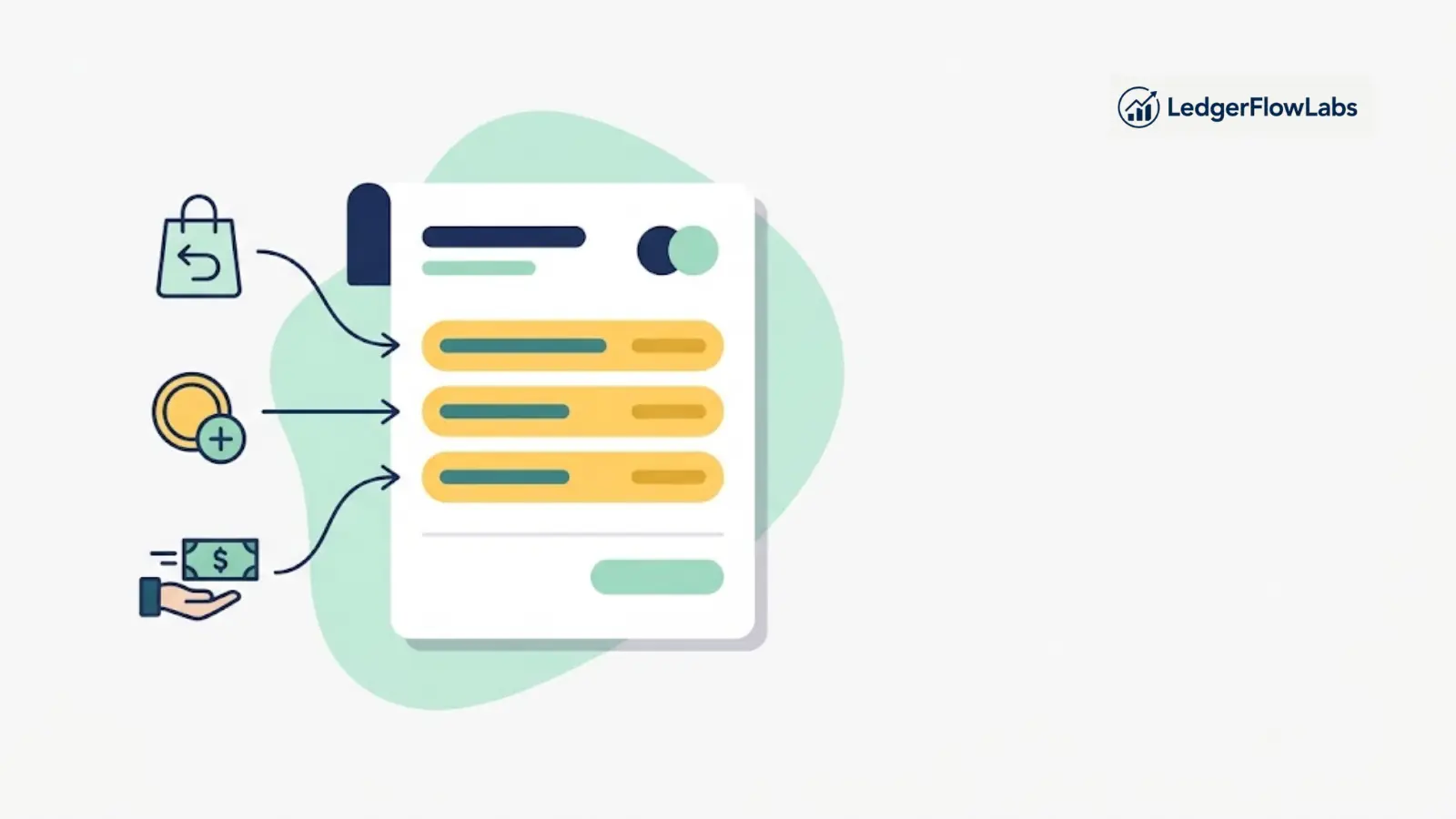
Statement credit vs refund is less of a contest than it sounds. On a credit card, a merchant refund almost always arrives as a statement credit. "Statement credit" is the wider term for any amount the issuer puts back on the account: a refund, a rewards redemption, a price adjustment, a resolved dispute. A payment is different. It is money you send in, and it is the only one of the three that normally counts toward the minimum payment due. All three lower the balance, which is why they are easy to mix up on a statement.
Where this applies: consumer credit cards issued in the United States. The federal rules quoted below are from Regulation Z.
This article explains how statement lines are labeled. It is general information, not financial or legal advice.
The three lines side by side
The fastest way to see the difference is to compare what each line does to the account. The table below describes the usual pattern. The card agreement governs any specific account.
| Payment | Merchant refund | Other statement credit | |
|---|---|---|---|
| Where the money comes from | You, from a bank account or other source | The merchant, through the card network | The card issuer (rewards, offers, dispute outcomes) |
| Lowers the balance | Yes | Yes | Yes |
| Usually counts toward the minimum payment | Yes | Typically no | Typically no |
| Where it tends to appear | A "Payments" line or section | Among transactions, often labeled as a return or credit, with the merchant's name | Among transactions or credits, often labeled with the program or reason |
| Can create a credit balance | Yes, if it exceeds what is owed | Yes | Yes |
Capital One's education page What Is a Statement Credit?, read on September 27, 2026, puts the key point plainly: "Statement credits typically don't count as a payment toward your credit card bill." The same page lists the common sources of a statement credit as a return, a price adjustment, redeeming rewards, a qualifying purchase, a sign-up bonus, and a disputed charge.
What a payment is, on the statement
A payment is money sent to the card issuer to pay down what is owed. It is the line the due date is about. When a statement says a minimum payment is due by a certain date, it is asking for a payment, not for any credit to arrive.
Payments usually appear in their own group, often labeled "Payments" or "Payments and Other Credits," with the date the payment was credited. That date matters more than the date the money left the bank, and the two are not always the same. When a payment is actually late explains the cutoff times and the different clocks involved.
What a refund is, on the statement
When an item bought on a credit card is returned, the store does not hand back cash to the cardholder. It sends a credit to the card issuer, and the issuer posts it to the account. That credit is the refund.
Regulation Z sets a two-step timeline for this. The CFPB's published text of Regulation Z, section 1026.12(e), read on September 27, 2026, says a merchant that accepts a return "shall, within 7 business days from accepting the return or forgiving the debt, transmit a credit statement to the card issuer." It then says: "The card issuer shall, within 3 business days from receipt of a credit statement, credit the consumer's account with the amount of the refund."
So a refund has two clocks: the merchant's, then the issuer's. The second clock starts only when the issuer receives the credit statement. A refund can also show as pending for a while before it posts, the same way a purchase can; pending vs posted transactions covers why the timing moves.
A refund is not the same as store credit
If a store gives a gift card or store credit instead of refunding the card, nothing arrives on the credit card statement. The original purchase stays on the balance, and it is still owed to the card issuer.
Other statement credits: rewards, offers and disputes
Not every credit comes from a merchant. Issuers post credits of their own, and the statement description usually names the reason.
- Rewards redemptions. Cash back or points turned into a credit on the account.
- Card offers and benefits. A credit tied to a qualifying purchase or a sign-up bonus, under that card's own terms.
- Dispute outcomes. When a disputed charge is resolved in the cardholder's favor, the amount comes back as a credit. Some issuers post a temporary credit while a dispute is investigated, and a temporary credit can be reversed if the dispute is not resolved that way.
- Fee or interest reversals. An issuer that removes a fee usually shows the removal as a credit rather than deleting the original line.
These lines are easy to misread as a payment because they reduce the balance. They are not payments, and the Capital One page quoted above says statement credits typically do not count toward the bill in the way a payment does.
Why a credit does not usually cover the minimum payment
This is the practical difference that catches people. Picture a statement with a minimum payment due, and then a large refund posting a few days later. The balance drops, sometimes a lot, but the minimum payment box on the statement that was already issued does not change, and the issuer may still expect a payment by the due date.
The exact treatment depends on the card agreement, and some issuers handle a credit that wipes out the whole balance differently. That is why the safest reading of a refund is "this lowers what is owed," not "this counts as this month's payment." The card agreement, or the issuer's customer service, is the place to confirm how a specific account treats it.
How a credit changes the interest calculation
A credit also has a quieter effect. On most cards, interest is calculated on the average of the daily balances during the billing cycle. A refund that posts on day 10 of a 30-day cycle lowers the balance for the remaining 20 days, so it reduces the average, and with it any interest for that cycle.
It does not reach backward. The days before the credit posted are still counted at the higher balance. The average daily balance method shows this arithmetic with a worked example, and it explains why the posting date on the credit matters as much as the amount.
When the credits add up to more than you owe
A refund or credit that arrives after the balance was already paid can push the account below zero. The statement then shows a negative balance, also called a credit balance.
Chase's education page on how refunds and returns work, read on September 27, 2026, describes this case: "If you paid off your entire credit card balance before you made the return, the statement will appear on your credit card as a negative balance. This means that the credit issuer owes you this amount."
Regulation Z, section 1026.11, sets what happens to a credit balance over $1. The CFPB's published text, read on September 27, 2026, requires the creditor to credit the amount to the account, to refund what remains within seven business days of a written request from the cardholder, and to make a good faith effort to refund any credit balance still left after six months, by cash, check, money order or a credit to a deposit account.
A note on rewards after a refund
When a purchase is refunded, the rewards earned on it usually go too. Chase's page states that "The reward points earned through the purchase will be deducted from your point earnings (which can include bonus points) once the transaction has posted to your account." Other issuers set their own rules in the rewards terms, so the rewards summary on the statement may drop in the same month the refund appears.
Frequently asked questions
Is a statement credit the same as a refund?
Not exactly. A refund on a credit card usually arrives as a statement credit, but statement credit is the wider term. It also covers rewards redemptions, card offers, dispute outcomes and fee reversals. Every refund to a card is a credit; not every credit is a refund.
Does a refund count as my credit card payment?
Typically not. Capital One's education page, read on September 27, 2026, says statement credits typically do not count as a payment toward the bill. A refund lowers the balance, but the minimum payment due is usually still expected by the due date. The card agreement sets the exact rule.
How long does a credit card refund take to show up?
Under Regulation Z, section 1026.12(e), a merchant has 7 business days from accepting a return to send a credit statement to the card issuer, and the issuer then has 3 business days from receiving it to credit the account. It may appear as pending before it posts.
What happens if a refund makes my balance negative?
The account shows a credit balance, meaning the issuer owes that amount to the cardholder. Under Regulation Z, section 1026.11, a credit balance over $1 must be refunded within seven business days of a written request, and the issuer must make a good faith effort to refund it after six months.